
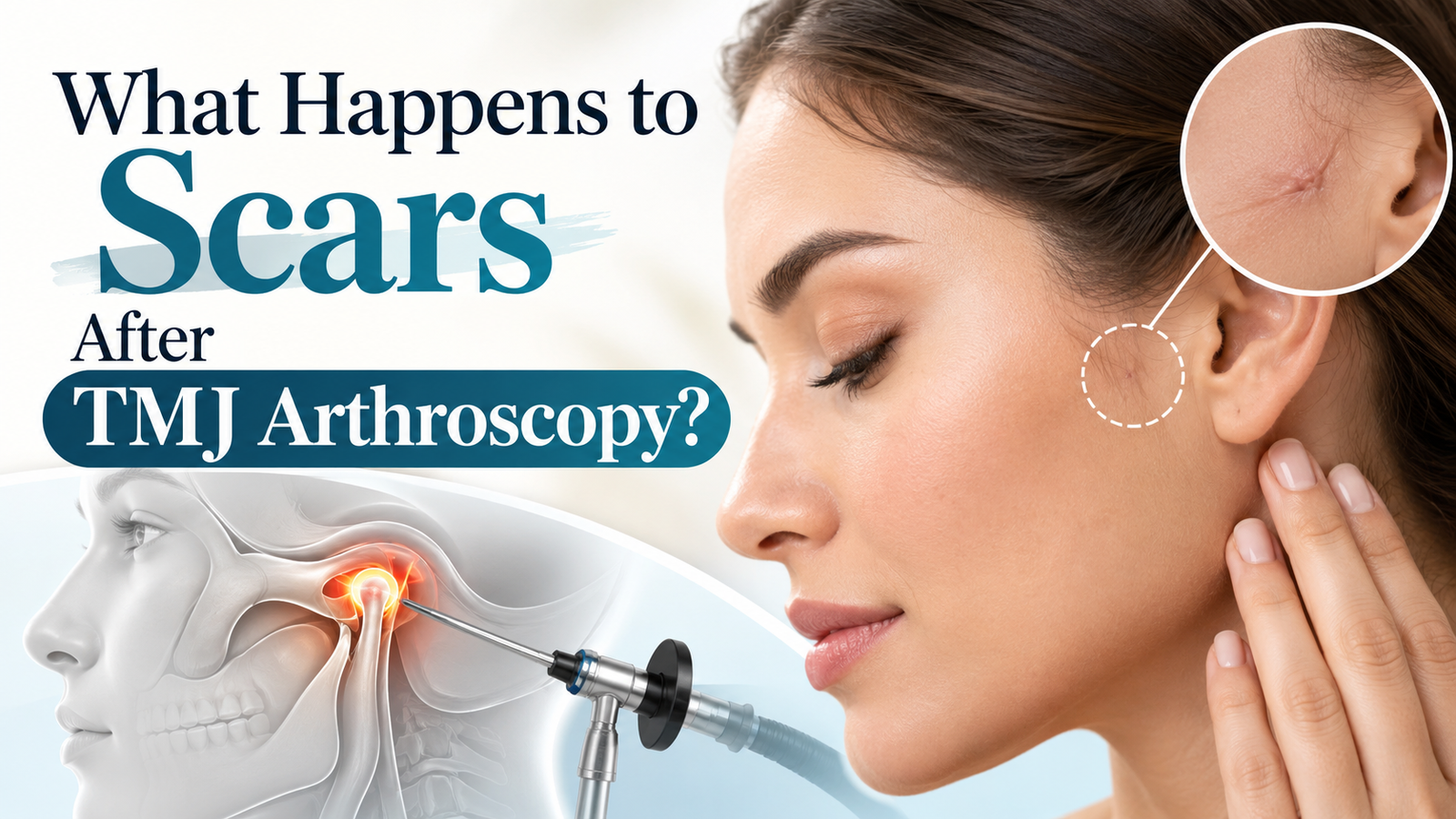
What happens to scars after TMJ arthroscopy?
- Home
- Blog
"Doctor, will I have a scar on my face?" — this is one of the first questions my patients ask when I recommend TMJ arthroscopy. It is a completely fair concern. The jaw joint sits right in front of the ear, on a part of the face everyone can see. So let me walk you through exactly what happens to the skin after this procedure, how the marks heal, and what you can do to help them fade.
Quick Answer
- TMJ arthroscopy uses one or two tiny punctures (usually just a few millimetres) in front of the ear — not a long cut.
- The marks look pink at first, then gradually fade over 3–6 months, and keep maturing for up to a year.
- For most patients, the final result is a small dot or fine line that is very hard to spot, often hidden in the natural skin crease near the ear.
Why TMJ Arthroscopy Leaves Such Small Scars
TMJ arthroscopy is a minimally invasive "keyhole" procedure. Instead of opening the joint through a larger incision, I pass a very thin camera (the arthroscope) and fine instruments into the joint space through small puncture points. Through these, I can wash out the joint, release adhesions, smooth irregular surfaces, and treat the disc where needed.
Because the entry points are so small, the skin has very little to repair. Wherever possible, I place them along the natural fold just in front of the ear, so that even while healing they blend into existing lines on the face. This is one of the big advantages of arthroscopy over open joint surgery, which requires a longer incision.
How Your Scar Heals: A Week-by-Week Timeline
Every scar goes through the same biological stages. Knowing them helps you understand that a pink or slightly firm mark in the early weeks is normal — it is not the final result.
| Time after surgery | What you will notice | What is happening underneath |
|---|---|---|
| Days 1–7 | Small dressings or strips; mild swelling and tenderness in front of the ear. | Inflammatory phase — the body seals the puncture and fights off germs. |
| Weeks 1–3 | Stitches or strips removed; marks look pink or red and may feel slightly raised. | Proliferative phase — new collagen and blood vessels fill in the wound. |
| Months 1–3 | Colour starts to soften; the mark flattens and becomes less noticeable. | Remodelling begins — collagen fibres reorganise and strengthen. |
| Months 3–6 | Most patients find the mark hard to see, especially in the skin fold. | Remodelling continues; blood supply to the scar reduces, so redness fades. |
| 6–12 months | Final appearance — usually a pale dot or fine line close to normal skin colour. | Scar fully matures. |
I always tell my patients: judge your scar at one year, not at one month. The skin keeps improving long after the joint itself feels better.
My Scar-Care Advice for Patients
Good surgical technique does most of the work, but your aftercare makes a real difference. Here is what I recommend to my own patients:
1. First 48 Hours: Keep It Clean and Dry
Leave the dressing in place as advised. Avoid getting the area wet, and do not rub or press on it.
2. Until the Skin Is Fully Closed: Gentle Hygiene Only
Clean around the marks gently as instructed. Avoid swimming, steam rooms, and heavy makeup over the area until the punctures have completely sealed and any stitches are out.
3. Do Not Pick or Scratch
Small scabs are part of healing. Pulling them off early can widen the scar and increase the chance of dark marks.
4. Silicone Gel or Sheets (From Around Week 2)
Once the skin has fully closed, silicone gel is one of the best-supported options for helping scars stay flat and soft. Apply a thin layer as directed, usually for a few months. Please check with me before starting any product.
5. Sun Protection — Very Important
New scar tissue darkens easily in sunlight, and this is a particular concern in Indian and other darker skin types, where post-inflammatory hyperpigmentation is common. Use a broad-spectrum sunscreen (SPF 30 or higher) on the area daily for at least 6 months, even on cloudy days.
6. Gentle Massage (After 3–4 Weeks, If Advised)
Light circular massage over the healed mark for a minute or two a day can help soften it. Only start when your surgeon confirms the skin is ready.
7. Support Healing From the Inside
Avoid smoking, which reduces blood flow to healing skin. Eat a balanced, protein-rich soft diet during your jaw recovery, stay hydrated, and keep conditions like diabetes well controlled.
Who Is More Likely to Have a Noticeable Scar?
Most people heal beautifully, but a few factors can make a scar more visible:
- Personal or family history of keloids or raised (hypertrophic) scars
- Darker skin tones, which are more prone to temporary dark marks
- Smoking or poorly controlled diabetes
- Infection at the puncture site
- Sun exposure without protection in the early months
If any of these apply to you, please tell me during your consultation. We can plan extra preventive care — for example, starting silicone therapy early and following up more closely — so that any problem is caught and treated at the right time.
What If a Scar Doesn't Fade as Expected?
In the uncommon case that a mark stays raised, thick, itchy, or dark, there are effective treatments available. Depending on the type of scar, options may include continued silicone therapy, steroid injections for raised scars, topical treatments for pigmentation, or laser and other procedures for a minor scar revision. The key is to come back early rather than wait — early scars respond better to treatment.
Contact Your Surgeon Promptly If You Notice:
- Increasing redness, warmth, or swelling around the puncture site after the first few days
- Pus or unusual discharge from the wound
- Fever
- A scar that is growing beyond the original wound edges
- New weakness in the forehead or eyelid, or numbness that is not improving
TMJ Arthroscopy vs Open Joint Surgery: Scar Comparison
| TMJ Arthroscopy | Open TMJ Surgery | |
|---|---|---|
| Skin opening | 1–2 tiny punctures (a few mm) | Longer incision in front of / around the ear |
| Visible result | Small dot or fine line, usually very hard to see | Fine line, usually well hidden in skin creases but longer |
| Skin healing time | Closed within about 1–2 weeks | Usually longer |
My Message to You
If you are living with jaw pain, clicking, locking, or difficulty opening your mouth, a fear of scarring should not stop you from getting the right treatment. TMJ arthroscopy is designed to relieve joint problems with the smallest possible impact on your skin. With careful technique and simple aftercare, the vast majority of my patients are left with marks that even they struggle to find a year later.
If you have questions about your own case — your skin type, your history of scarring, or whether arthroscopy is right for you — I'm happy to discuss them in detail during your consultation.
Frequently Asked Questions
Will TMJ arthroscopy leave a visible scar?
The procedure uses one or two tiny punctures in front of the ear. In most patients these fade to a small dot or fine line that is very hard to notice once healing is complete.
How long does it take for the scar to fade?
Expect pinkness for the first few weeks, noticeable lightening over 2–3 months, and continued improvement for up to 12 months. Most patients find the marks barely visible by 3–6 months.
When can I start using scar gel?
Usually around 2 weeks after surgery, once the skin has fully closed and stitches or strips are removed. Always confirm with your surgeon first.
Can I wear makeup over the area?
Wait until the punctures have completely healed — usually 1–2 weeks. After that, light makeup is fine, but remove it gently and keep using sunscreen.
Can TMJ arthroscopy scars become keloids?
It is uncommon with such small punctures, but people with a history of keloids or darker skin types have a higher risk. Let your surgeon know in advance so preventive care can be planned.
Disclaimer: This article is for general educational purposes and does not replace personal medical advice. Healing timelines vary between individuals. Please follow the specific instructions given by your treating surgeon.