
TMJ arthroscopy scar
- Home
- Blog
TMJ Arthroscopy Scar: What to Expect
By Dr. Tofiq Bohra, Oral & Maxillofacial Surgeon (TMJ Arthroscopy & Total Joint Replacement), Mumbai
For many patients, especially young people, one of the biggest worries about jaw joint surgery isn't pain. It's the face. "Will I have a scar? Will people notice it?" It's a completely valid concern, because the jaw joint sits right in front of the ear, on a very visible part of the face.
The good news is that with TMJ arthroscopy, scarring is minimal. In this article, I'll explain where the marks are, what they look like as they heal, and how you can help them fade.
Why TMJ Arthroscopy Leaves Such a Small Scar
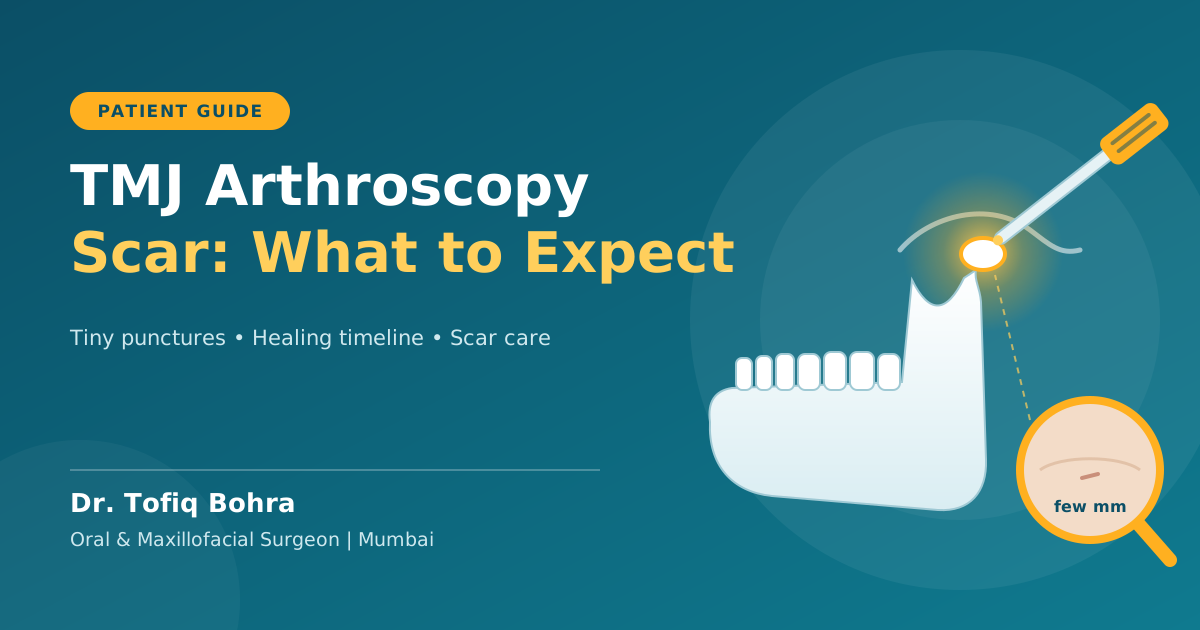
TMJ arthroscopy is a "keyhole" procedure. Instead of opening the joint with a larger incision, a very thin camera, only a few millimetres wide, enters the joint through a tiny puncture. Sometimes a second small puncture is used for instruments.
Because the skin opening is so small, it often needs only a single stitch or adhesive strips, and it heals much like a small nick.
Where Is the Scar Located?
The punctures are made just in front of the ear, over the jaw joint. They are usually placed close to the natural crease where the ear meets the cheek, so that once healed they blend in with the skin. Hair, especially in men with sideburns, can make them even less visible.
TMJ Arthroscopy Scar vs Open Surgery Scar
| Feature | TMJ Arthroscopy | Open Joint Surgery |
|---|---|---|
| Size | 1–2 tiny punctures, a few mm each | A longer incision, usually a few centimetres |
| Location | In front of the ear | In front of the ear, often within the skin crease |
| Stitches | One stitch or adhesive strips | A line of stitches |
| Final appearance | Usually barely noticeable | A fine line that fades but may remain visible up close |
How the Scar Heals: A Typical Timeline
- First few days: The puncture site is covered with a small dressing. Mild swelling around the ear is normal.
- About 1 week: Stitches, if used, are removed or dissolve. The mark looks like a small pink dot or line.
- 1–3 months: The pinkness gradually fades and the mark flattens.
- 3–6 months and beyond: In most patients, the scar becomes pale and blends with the surrounding skin.
Healing varies from person to person, depending on skin type, age and genetics.
How to Help Your Scar Heal Well
- Keep it clean and dry for the first day or two, as advised by your surgeon.
- Don't pick or scratch any scab. Let it fall off naturally.
- Protect it from the sun for a few months. Sun exposure can darken a healing scar, especially on Indian skin.
- Use scar gel if advised. Once the wound has fully healed, a silicone scar gel can help the mark fade.
- Attend your follow-up visits so any healing issue can be caught early.
Is There a Risk of a Bad Scar?
Problem scars after TMJ arthroscopy are uncommon. However, a few factors can affect how a scar heals:
- Keloid tendency: If you have had raised or thick scars (keloids) before, tell your surgeon in advance.
- Darker skin types: Some people may notice temporary darkening of the scar (hyperpigmentation), which usually fades with sun protection and time.
- Infection: Rare, but it can affect healing, so follow wound-care advice carefully.
If a scar does become raised or dark, treatments such as silicone sheets, steroid injections or other skin treatments can help.
My Advice
If the fear of a scar is holding you back from treating a painful or locked jaw, I'd encourage you to discuss it openly with your surgeon. With TMJ arthroscopy, the cosmetic impact is usually very small, while the improvement in pain and jaw movement can make a big difference to daily life.
You can read more about the procedure and my approach as a TMJ arthroscopy surgeon in Mumbai.
Frequently Asked Questions
Does TMJ arthroscopy leave a scar?
Yes, but it is very small. TMJ arthroscopy leaves one or two tiny puncture marks in front of the ear, which usually fade to become barely noticeable over a few months.
How big is the TMJ arthroscopy scar?
Each puncture mark is only a few millimetres long, much smaller than the incision used for open joint surgery.
How long does a TMJ arthroscopy scar take to fade?
The mark usually fades significantly within 1–3 months and continues to improve for up to 6 months or more, depending on your skin.
Will people be able to see my scar?
In most patients, once healed, the marks are hard to notice, especially as they are placed close to the natural skin crease in front of the ear.
What can I do to reduce scarring after TMJ arthroscopy?
Keep the area clean, avoid picking at it, protect it from the sun, and use a silicone scar gel once the wound has fully healed, if your surgeon advises it.
Worried about scarring from jaw surgery?
Book a consultation with Dr. Tofiq Bohra to learn how minimally invasive TMJ arthroscopy can treat your jaw with minimal scarring.
Book an AppointmentDisclaimer: This article is for general information only and is not a substitute for a medical consultation. Healing and scarring vary from patient to patient.