
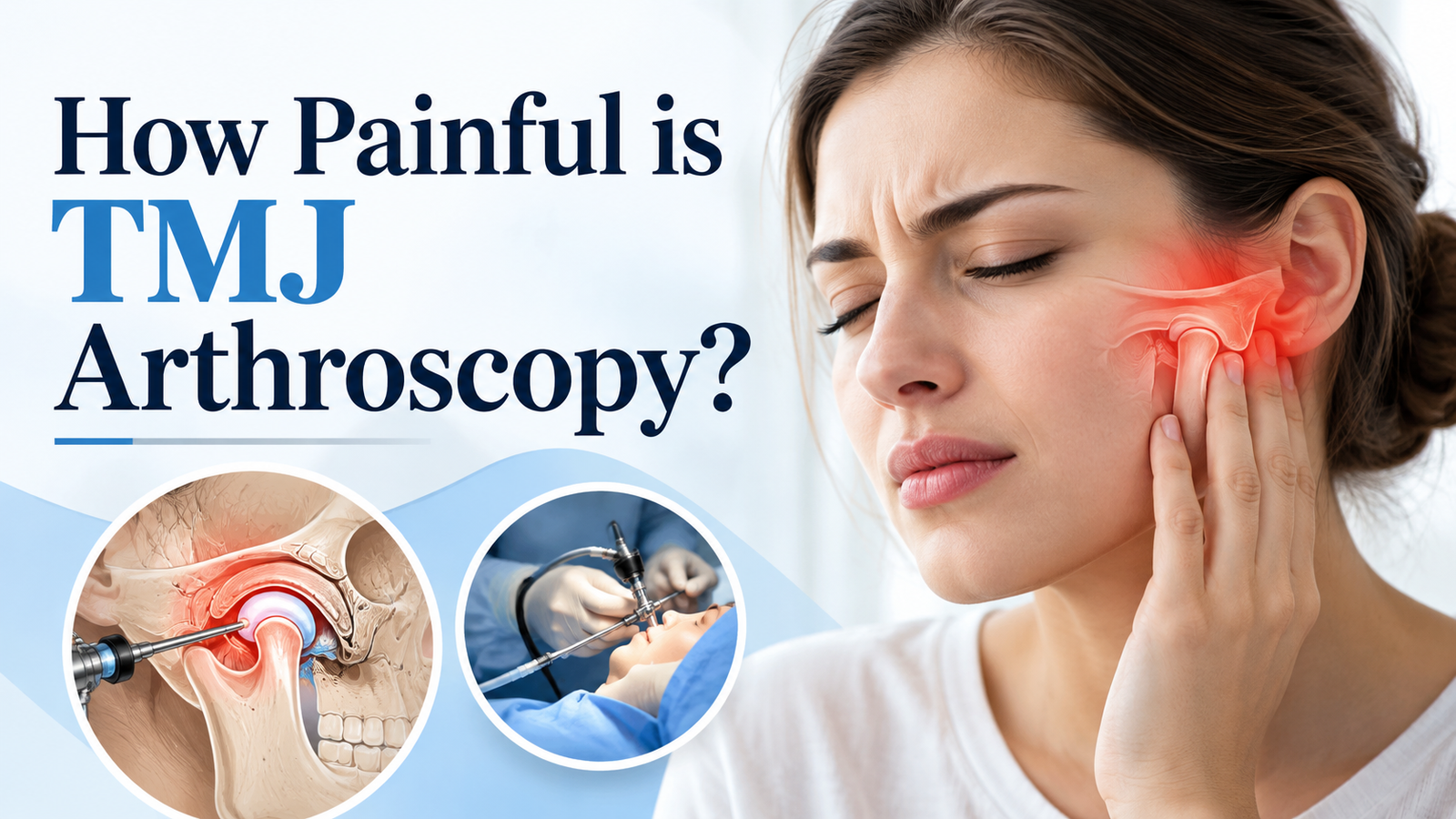
How painful is TMJ arthroscopy?
- Home
- Blog
"Will it hurt?" Almost every patient asks me this before TMJ arthroscopy, and I understand why. Many of them have already lived with jaw pain for months or even years, and the last thing they want is more of it. The honest answer is reassuring: you will not feel pain during the procedure, and the discomfort afterwards is usually mild to moderate, short-lived, and well controlled with simple medicines. Let me explain what you can realistically expect at each stage.
Quick Answer
- During the procedure: no pain. It is done under general anaesthesia or deep sedation.
- First 2–3 days: soreness, stiffness, and a feeling of fullness in front of the ear. This is the most uncomfortable period, and regular pain medicine usually manages it well.
- After the first week: most patients have only mild tenderness and stiffness, which keeps improving as they do their jaw exercises.
- TMJ arthroscopy is generally much less painful than open jaw joint surgery, because it uses only tiny punctures.
Why TMJ Arthroscopy Is Less Painful Than You Might Think
TMJ arthroscopy is a minimally invasive "keyhole" procedure. I do not open the joint with a large incision. Instead, I pass a very thin camera and fine instruments into the joint through one or two small punctures just in front of the ear. Through these, I can wash out inflammatory fluid, release adhesions, and treat the joint surfaces and disc.
Because the skin and muscles are barely disturbed, there is far less tissue trauma, and less tissue trauma means less pain. In fact, many patients notice that the deep, nagging joint pain they had before surgery starts to ease once the inflamed fluid has been washed out of the joint.
What You Feel During the Procedure
Nothing. TMJ arthroscopy is usually done under general anaesthesia, so you are fully asleep. In selected cases, it may be done under deep sedation with local anaesthesia. Either way, you will not feel the procedure.
At the end of the procedure, I often place long-acting local anaesthetic around the joint, and sometimes medication inside the joint. This means that when you wake up, the area is often still numb, which gives you a comfortable start to recovery.
Pain After TMJ Arthroscopy: A Day-by-Day Guide
| Time after surgery | What patients commonly feel | How we manage it |
|---|---|---|
| Day of surgery | Grogginess from anaesthesia; the area may still be numb. Some mild ache as the numbness wears off. | Prescribed pain relief started on time, ice packs, rest with the head raised. |
| Days 1–3 | Soreness in front of the ear, swelling, jaw stiffness, a blocked or "full" feeling in the ear. The bite may feel slightly off on the treated side. | Regular (not "only when needed") pain medicine, cold compresses, soft diet, gentle movement as advised. |
| Days 4–7 | Pain clearly reducing. Stiffness is now the main complaint. | Switch to warm moist compresses, begin or continue jaw exercises. |
| Weeks 2–4 | Mild tenderness, mostly after chewing or longer conversations. Mouth opening improving. | Exercises, gradual return to normal diet, medicine only if needed. |
| 1–3 months | Joint continues to settle. Many patients notice their original TMJ pain is much better than before surgery. | Continue exercises and follow-up reviews. |
Most of my patients tell me that the recovery was easier than they had feared, and that the soreness after surgery was nothing compared to the pain they had been living with before.
Common Sensations That Are Normal
Some feelings after TMJ arthroscopy can be worrying if you are not expecting them. These are normal and temporary:
- Ear fullness or muffled hearing: the joint sits right next to the ear canal, so swelling can make the ear feel blocked for a few days.
- Bite feels different: fluid used to wash the joint can make the back teeth on that side not meet properly for a few days. This usually settles on its own.
- Jaw stiffness: the muscles around the joint tighten up after surgery. Exercises steadily loosen them.
- Mild swelling in front of the ear: usually peaks in the first 48 hours, then goes down.
- Numbness of the skin around the puncture site: usually temporary.
How I Help My Patients Stay Comfortable
1. Take Pain Medicine Regularly at First
For the first 2–3 days, take your prescribed medicines on a schedule rather than waiting for pain to build up. It is much easier to stay ahead of pain than to chase it. Most patients do well with anti-inflammatory medicines and paracetamol; stronger medicine is needed only occasionally.
2. Cold First, Then Warm
Use ice packs (wrapped in a cloth) in front of the ear for the first 48 hours to reduce swelling. After that, warm moist compresses help relax tight jaw muscles.
3. Soft Diet
Eat soft foods such as khichdi, dal, curd, soups, mashed vegetables, eggs, and smoothies for the first couple of weeks. Avoid hard, chewy, or very large bites, and do not chew gum.
4. Start Jaw Exercises Early
Gentle exercises, usually started within the first few days, are one of the most important parts of recovery. They prevent stiffness and help the joint move smoothly. Some discomfort while exercising is expected, but sharp pain means you should slow down and tell me.
5. Rest Your Jaw
Avoid yawning wide, shouting, long phone calls, and clenching your teeth. If you grind your teeth at night, wear your night guard as advised.
6. Sleep With Your Head Raised
An extra pillow for the first few nights helps reduce swelling. Try not to sleep on the operated side.
When Can I Get Back to Normal Life?
- Desk work or studies: most patients return within a few days to a week.
- Driving: once you are off any drowsy pain medicines and can turn your head comfortably.
- Exercise and gym: light activity after about a week; heavy lifting and contact sports only after your surgeon clears you.
- Normal diet: gradually over a few weeks, depending on how your jaw feels.
TMJ Arthroscopy vs Open Joint Surgery: Pain Comparison
| TMJ Arthroscopy | Open TMJ Surgery | |
|---|---|---|
| Skin opening | 1–2 tiny punctures | Longer incision in front of / around the ear |
| Post-operative pain | Usually mild to moderate, mostly in the first few days | Usually more, and for longer |
| Hospital stay | Often same day or overnight | Usually longer |
| Return to routine | Within days to a week for most patients | Usually a few weeks |
Contact Your Surgeon Promptly If You Notice:
- Pain that is getting worse instead of better after the first 3 days, or is not controlled by your medicines
- Increasing swelling, redness, or warmth around the joint
- Fever or pus from the puncture site
- Ear pain with discharge, or hearing that does not return to normal
- Weakness in the forehead or difficulty closing the eye
- Sudden inability to open or close your mouth
My Message to You
If you are living with jaw pain, clicking, locking, or limited mouth opening, fear of post-operative pain should not keep you from treatment that can genuinely help. TMJ arthroscopy is one of the gentlest surgical options for the jaw joint. With good anaesthesia, a clear pain-relief plan, and early exercises, most patients find the recovery very manageable.
Every patient's pain threshold and joint condition is different. During your consultation, I will explain what to expect in your specific case and plan your pain control in advance, so you go into surgery feeling prepared rather than anxious.
Frequently Asked Questions
Is TMJ arthroscopy painful?
You will not feel anything during the procedure, as it is done under anaesthesia. Afterwards, most patients have mild to moderate soreness for the first few days, which is well controlled with regular pain medicine.
How long does pain last after TMJ arthroscopy?
The most noticeable soreness is usually in the first 2–3 days. It reduces a lot by the end of the first week, and any remaining tenderness or stiffness continues to improve over the following weeks.
Will I need strong painkillers?
Most patients manage well with anti-inflammatory medicines and paracetamol. Stronger medicines are needed only occasionally, for a short time.
Why does my ear feel blocked after surgery?
The jaw joint is right next to the ear canal. Swelling and fluid from the procedure can make the ear feel full or muffled for a few days. This normally settles on its own.
Is TMJ arthroscopy less painful than open jaw surgery?
Yes, in general. Because it uses tiny punctures instead of a larger incision, there is less tissue disturbance, less post-operative pain, and a faster return to normal activities.
Disclaimer: This article is for general educational purposes and does not replace personal medical advice. Pain and recovery vary between individuals. Please follow the specific instructions given by your treating surgeon.