
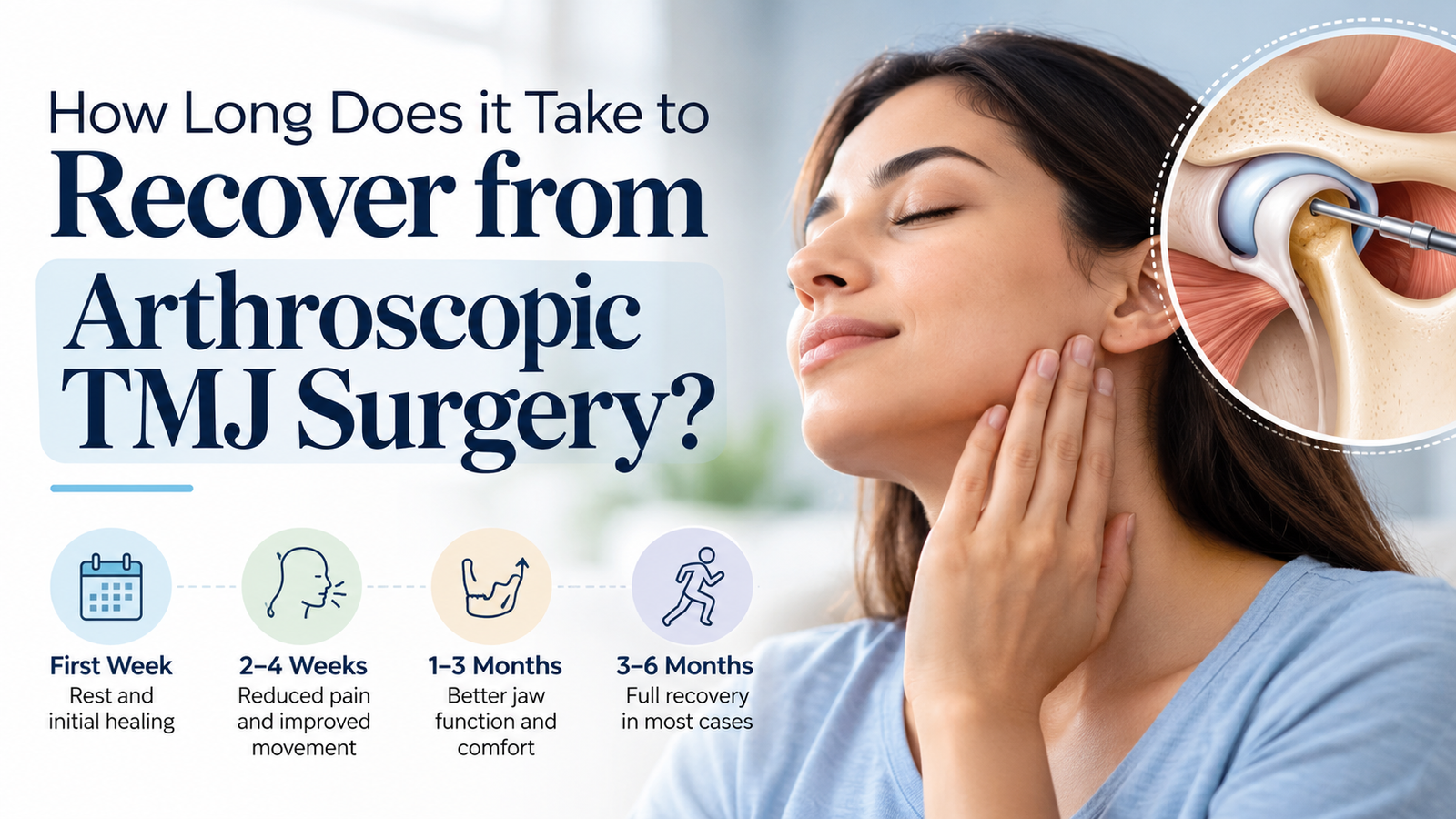
How long does it take to recover from arthroscopic TMJ surgery?
- Home
- Blog
When I discuss TMJ arthroscopy with my patients, the next question after "Will it hurt?" is almost always "How long before I'm back to normal?" People want to know when they can return to work, eat their favourite food again, and finally stop thinking about their jaw. The good news is that arthroscopic TMJ surgery has one of the quickest recoveries of any jaw joint procedure. Here is a realistic picture of what recovery looks like, stage by stage.
Quick Answer
- Going home: usually the same day or the next morning.
- Back to desk work or college: typically within 3–7 days.
- Soft diet: usually for 2–3 weeks, then gradually back to normal food.
- Jaw exercises / physiotherapy: usually continued for 4–6 weeks or longer.
- Full benefit of the surgery: the joint keeps settling and improving for 3–6 months.
Why Recovery Is Faster With Arthroscopy
TMJ arthroscopy is a keyhole procedure. Instead of opening the joint through a larger incision, I work through one or two tiny punctures in front of the ear using a thin camera and fine instruments. This lets me wash out inflammatory fluid, release adhesions, and treat the joint surfaces and disc with very little disturbance to the skin, muscles, and nerves around the joint.
Less tissue disturbance means less swelling, less pain, and a much quicker return to daily life compared with open joint surgery.
Recovery Timeline: What to Expect Week by Week
| Stage | What is typical | What you should be doing |
|---|---|---|
| Day of surgery | Drowsiness from anaesthesia; area may be numb. Most patients go home the same day or next morning. | Rest with your head raised, ice packs, take prescribed medicines, liquid or very soft diet. |
| Days 1–3 | Soreness, swelling, jaw stiffness, ear fullness. Bite may feel slightly off on the treated side. | Regular pain medicine, cold compresses, soft diet, gentle jaw movements as advised. |
| Days 4–7 | Swelling and pain clearly reducing. Stiffness is the main complaint. | Warm moist compresses, start or continue jaw exercises. Many patients return to desk work. |
| Weeks 2–3 | Mild tenderness, mostly after chewing. Mouth opening steadily improving. | Continue exercises, attend follow-up, slowly add softer solid foods. |
| Weeks 4–6 | Most daily activities feel normal. Eating is much easier. | Gradual return to a normal diet; light exercise and gym as cleared. |
| 3–6 months | Joint continues to heal and settle. Most patients notice the full improvement in pain, clicking, and opening by this stage. | Keep protecting the joint: avoid habits like gum chewing and clenching, and wear a night guard if advised. |
I tell my patients to think of recovery in two parts: getting back to routine, which takes days, and the joint fully healing, which takes months. Both matter.
When Can I Return to Normal Activities?
| Activity | Typical timeline* |
|---|---|
| Desk work, studies, online meetings | 3–7 days |
| Driving | Once off drowsy medicines and able to turn your head comfortably — often within a few days |
| Physical or outdoor work | 1–2 weeks |
| Walking and light exercise | Within the first week |
| Gym, running, heavy lifting | About 2–3 weeks, once cleared |
| Contact sports | Usually after 6 weeks, only once cleared by your surgeon |
| Air travel | Usually fine after a few days; discuss ear fullness with your surgeon first |
| Dental treatment requiring a wide-open mouth | Ideally postponed for 4–6 weeks unless urgent |
*These are general guidelines. Your own timeline depends on what was done inside your joint and how you are healing.
Diet During Recovery
Weeks 1–2: Soft Foods
Khichdi, dal, curd, soups, upma, mashed vegetables, scrambled eggs, idli, paneer bhurji, porridge, smoothies, and well-cooked rice are all good choices. Cut food into small pieces and take small bites.
Weeks 2–4: Softer Solids
Slowly add soft chapati, well-cooked vegetables, fish, and tender chicken as comfort allows.
After 4–6 Weeks: Gradual Return to Normal
Most patients can return to a normal diet. Even then, I advise avoiding very hard or chewy foods such as hard nuts, tough meat, raw carrots, and chewing gum for some time, as they put a heavy load on the joint.
Jaw Exercises: The Key to a Good Recovery
The success of arthroscopy depends not only on the surgery but also on what happens afterwards. Jaw exercises are usually started within the first few days. They prevent stiffness, stop scar tissue from forming inside the joint, and help restore smooth, comfortable movement.
- Do them several times a day as instructed, even when your jaw feels better.
- Some stretching discomfort is normal; sharp pain is not, so slow down and let me know.
- Many patients benefit from guided physiotherapy for 4–6 weeks or longer.
- Track your mouth opening (for example, how many fingers fit between your front teeth). Steady improvement is a good sign.
What Can Slow Down Recovery?
- Skipping jaw exercises, which is the most common reason for a slow recovery
- Long-standing joint problems, such as a disc that has been displaced or locked for a long time
- Clenching or grinding the teeth, especially at night
- Returning to hard foods too early
- Stress, which often increases jaw muscle tension
- Smoking, which slows healing
- Other conditions like arthritis, fibromyalgia, or uncontrolled diabetes
Tips I Give My Patients for a Smoother Recovery
1. Plan Ahead
Stock up on soft foods, ice packs, and your prescribed medicines before surgery. Arrange a few days off work and someone to drive you home.
2. Stay Ahead of Pain
Take pain medicines regularly for the first 2–3 days rather than waiting for pain to build. Being comfortable makes it easier to do your exercises.
3. Cold First, Then Warm
Ice for the first 48 hours to control swelling, then warm moist compresses to relax the jaw muscles.
4. Rest Your Jaw
Avoid wide yawning, shouting, long phone calls, and resting your chin on your hand. Keep your teeth apart and your jaw relaxed during the day.
5. Protect the Joint at Night
Sleep with your head slightly raised, avoid sleeping on the operated side, and wear your night guard if one has been prescribed.
6. Don't Miss Follow-Up Visits
Follow-ups let me check your mouth opening, adjust your exercises, and catch any problem early.
Arthroscopy vs Open TMJ Surgery: Recovery Comparison
| TMJ Arthroscopy | Open TMJ Surgery | |
|---|---|---|
| Hospital stay | Often same day or overnight | Usually longer |
| Return to desk work | About 3–7 days | Usually a few weeks |
| Swelling and pain | Usually mild to moderate, mainly in the first few days | Usually more, and for longer |
| Full recovery | Joint settles over about 3–6 months | Often longer |
Contact Your Surgeon Promptly If You Notice:
- Pain or swelling that is getting worse instead of better after the first few days
- Fever, redness, warmth, or pus around the puncture site
- Ear pain with discharge, or hearing that does not return to normal
- Weakness in the forehead or difficulty closing the eye
- Mouth opening that is getting worse instead of better
- Sudden locking of the jaw, or a bite that stays noticeably off after the first week
My Message to You
For most of my patients, arthroscopic TMJ surgery means a few uncomfortable days, a couple of weeks of soft food and careful habits, and then a steady return to normal life. The real reward comes over the following months, as the joint settles and the pain, clicking, or locking that brought them to me fades away.
Every joint and every patient is different. During your consultation, I will explain what your recovery is likely to look like based on your diagnosis and the treatment planned, so you can prepare your work, family, and routine with confidence.
Frequently Asked Questions
How long does it take to recover from arthroscopic TMJ surgery?
Most patients return to desk work within 3–7 days and to a mostly normal diet within 4–6 weeks. The joint continues to heal and improve for about 3–6 months.
Is TMJ arthroscopy a day-care procedure?
Often, yes. Many patients go home the same day, while some stay one night depending on their health and the procedure performed.
How long will I be on a soft diet?
Usually for about 2–3 weeks, followed by a gradual return to normal food over the next few weeks, depending on comfort and your surgeon's advice.
When will I see results from TMJ arthroscopy?
Many patients notice an improvement in pain and mouth opening within the first few weeks. The full benefit is usually seen by 3–6 months, especially if jaw exercises are done regularly.
Do I need physiotherapy after TMJ arthroscopy?
Jaw exercises are an essential part of recovery for almost every patient. Some patients also benefit from guided physiotherapy for several weeks to improve mouth opening and reduce stiffness.
Disclaimer: This article is for general educational purposes and does not replace personal medical advice. Recovery timelines vary between individuals and depend on the procedure performed. Please follow the specific instructions given by your treating surgeon.