
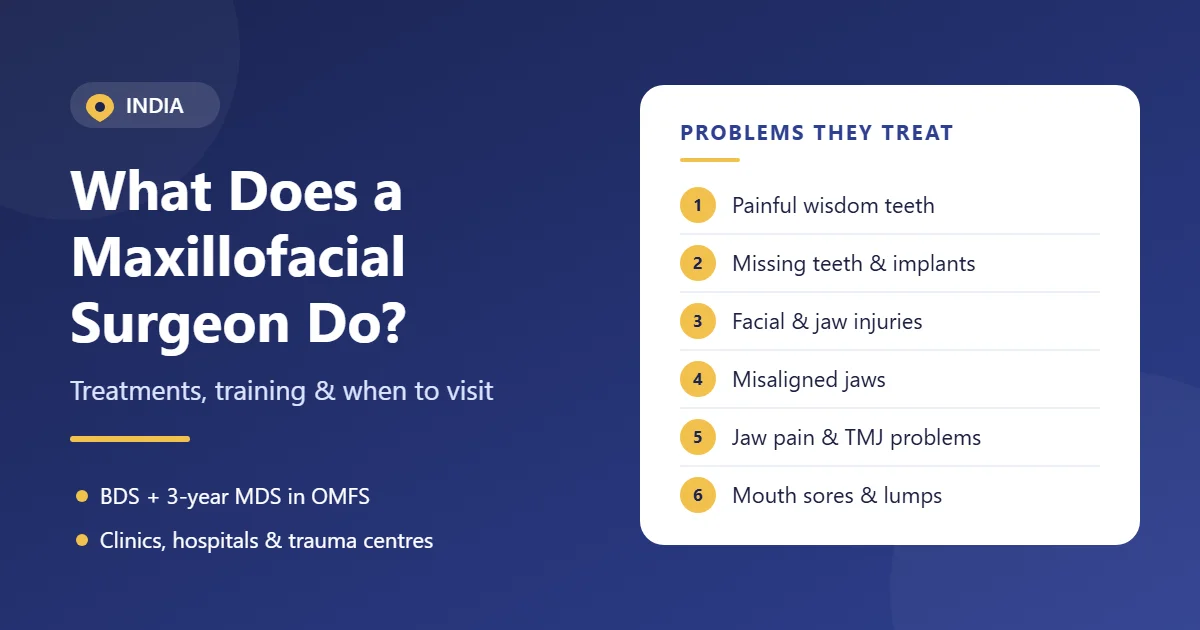
What does a maxillofacial surgeon do?
- Home
- Blog
A maxillofacial surgeon is a specialist who diagnoses and surgically treats problems of the mouth, jaws, face and neck. In India, you may see one for a painful wisdom tooth, missing teeth, a jaw injury after a road accident, jaw pain, or a sore in the mouth that will not heal. This guide explains what a maxillofacial surgeon does, the problems they treat, how they are trained in India and when you should see one.
Quick answer
- A maxillofacial surgeon treats surgical problems of the teeth, jaws, face, mouth and neck.
- Their work includes wisdom tooth removal, dental implants, jaw fracture repair, corrective jaw surgery, TMJ treatment, biopsies and oral cancer care.
- In India, they complete a BDS degree followed by a 3-year MDS in Oral and Maxillofacial Surgery.
- They work in dental clinics, hospitals, trauma centres, cancer centres and dental colleges.
Who Is a Maxillofacial Surgeon?
A maxillofacial surgeon, also called an oral and maxillofacial surgeon or OMFS, is a dental specialist with advanced surgical training. "Maxillofacial" refers to the jaws and face, so their work goes beyond the teeth to the bones, joints and soft tissues of the face.
Because they understand both dentistry and surgery, they are well suited to problems where teeth, jawbones and facial structures meet.
What a Maxillofacial Surgeon Does: By Problem
The easiest way to understand their work is to look at the problems patients bring to them.
"My wisdom tooth is painful and swollen."
Wisdom teeth often become stuck (impacted) under the gum or bone. A maxillofacial surgeon assesses the tooth with an X-ray or scan and removes it surgically if needed, usually under local anaesthesia.
"I have missing teeth."
The surgeon can place dental implants, which are small posts fixed into the jawbone to support artificial teeth. If the bone is too thin, they can first rebuild it with a bone graft or sinus lift.
"I injured my face in an accident."
Road traffic accidents are a common cause of facial injuries in India. Maxillofacial surgeons repair fractures of the jaw, cheekbone, eye socket and nose, as well as deep cuts to the face and mouth. They often work in hospital emergency and trauma teams.
"My jaws don't line up, and it is hard to chew."
For an underbite, overbite, open bite or facial asymmetry, the surgeon may recommend corrective jaw (orthognathic) surgery. This is usually planned together with an orthodontist, who straightens the teeth with braces before and after surgery.
"My jaw clicks, locks or hurts."
Many temporomandibular joint (TMJ) problems improve with splints, medicines and exercises. When they do not, a maxillofacial surgeon may offer procedures such as arthrocentesis, TMJ arthroscopy or open joint surgery.
"I can't open my mouth fully."
Limited mouth opening can have several causes, including jaw joint problems, infection, injury and oral submucous fibrosis, a condition commonly linked to chewing areca nut, gutkha or paan. The surgeon finds the cause and plans treatment, which may include surgery in some cases.
"I have a sore, lump or patch in my mouth."
A sore, lump, or red or white patch that does not heal within 2–3 weeks should be checked. The surgeon may take a small tissue sample (biopsy) to find out what it is. They also remove cysts and tumours of the jaws, and some specialise in oral cancer surgery and reconstruction.
"My face or neck is badly swollen from a tooth infection."
Serious dental infections can spread into the face and neck. A maxillofacial surgeon drains the infection and removes its source, sometimes as an emergency.
"My child was born with a cleft lip or palate."
Maxillofacial surgeons work with cleft care teams to repair the lip, palate and gum, and later correct jaw growth if needed.
Common Procedures at a Glance
| Procedure | Why it is done |
|---|---|
| Wisdom tooth removal | Pain, infection or damage from an impacted tooth |
| Dental implants | Replacing missing teeth |
| Bone grafting | Building up the jaw before implants |
| Jaw fracture fixation | Repairing broken jaw or facial bones |
| Orthognathic surgery | Correcting jaw alignment and bite |
| TMJ procedures | Treating jaw joint pain, locking and stiffness |
| Biopsy | Diagnosing mouth sores, lumps and patches |
| Cyst and tumour removal | Treating growths in the mouth and jaws |
| Abscess drainage | Treating serious dental and facial infections |
How Maxillofacial Surgeons Are Trained in India
- BDS: a Bachelor of Dental Surgery degree, followed by a compulsory internship.
- NEET MDS: the entrance exam for postgraduate dental courses.
- MDS in Oral and Maxillofacial Surgery: a 3-year postgraduate course with training in surgery, anaesthesia, trauma and hospital care.
- Fellowships (optional): extra training in areas such as implants, head and neck oncology, cleft and craniofacial surgery, or facial cosmetic surgery.
Practising surgeons should be registered with their State Dental Council.
Where Maxillofacial Surgeons Work
- Private dental and maxillofacial clinics
- Multispecialty and corporate hospitals
- Government hospitals and trauma centres
- Cancer hospitals
- Dental colleges, where they also teach and train students
Maxillofacial Surgeon vs. Dentist
| General dentist | Maxillofacial surgeon |
|---|---|
| BDS degree | BDS plus a 3-year MDS in surgery |
| Check-ups, cleaning, fillings, root canals, simple extractions | Complex extractions, implants, jaw surgery, trauma, TMJ, tumours |
| Mostly works in a dental clinic | Works in clinics as well as hospital operation theatres |
| Refers complex surgical cases | Receives referrals for surgical cases |
When Should You See a Maxillofacial Surgeon?
- Your dentist has referred you for surgery
- You have a painful or impacted wisdom tooth
- You want implants and may need bone grafting
- You have a jaw or facial injury
- Your bite is misaligned and affects eating or speaking
- You have jaw pain, clicking, locking or limited mouth opening
- You have a mouth sore, lump or patch that hasn't healed in 2–3 weeks
Go to an emergency department immediately if you have rapidly spreading swelling of the face or neck, difficulty breathing or swallowing, heavy bleeding, or a suspected broken jaw.
What Happens at Your First Visit?
- The surgeon asks about your symptoms, medical history and medicines.
- They examine your mouth, teeth, jaws, face and bite.
- They may order an OPG X-ray, a CBCT scan or other tests.
- They explain your diagnosis, treatment options, anaesthesia, recovery time and cost.
Frequently Asked Questions
Is a maxillofacial surgeon a doctor?
In India, a maxillofacial surgeon is a dental specialist with a BDS and an MDS in Oral and Maxillofacial Surgery. Some also hold an MBBS degree, but it is not required in India.
Do maxillofacial surgeons only remove teeth?
No. Tooth removal is only one part of their work. They also treat facial injuries, jaw deformities, TMJ disorders, cysts, tumours, infections and cleft conditions.
Do I need a referral to see a maxillofacial surgeon?
Usually not for private clinics and hospitals. Your dentist or doctor can still refer you to a suitable specialist.
Is maxillofacial surgery painful?
Procedures are done under local anaesthesia, sedation or general anaesthesia, so you should not feel pain during surgery. Some swelling and soreness afterwards is normal and can be controlled with medicines.
The Bottom Line
A maxillofacial surgeon treats surgical problems of the mouth, jaws, face and neck, from wisdom teeth and implants to facial injuries, jaw correction, TMJ disorders and oral disease. If you have a problem in this area that needs more than routine dental care, a qualified maxillofacial surgeon can diagnose it and explain the right treatment for you.
Medical disclaimer: This article is for general information only and is not a substitute for professional medical or dental advice. Always consult a qualified healthcare provider about your own condition.