
What is the difference between a dentist and a maxillofacial surgeon?
- Home
- Blog
Dentists and maxillofacial surgeons both care for your teeth and mouth, but their training and the treatments they provide are different. A dentist handles routine dental care, such as check-ups, fillings and root canals. A maxillofacial surgeon is a dental specialist trained to perform complex surgery on the teeth, jaws, face and neck. This guide explains the differences in training, treatments and work settings, and how to know which one you need.
Quick answer
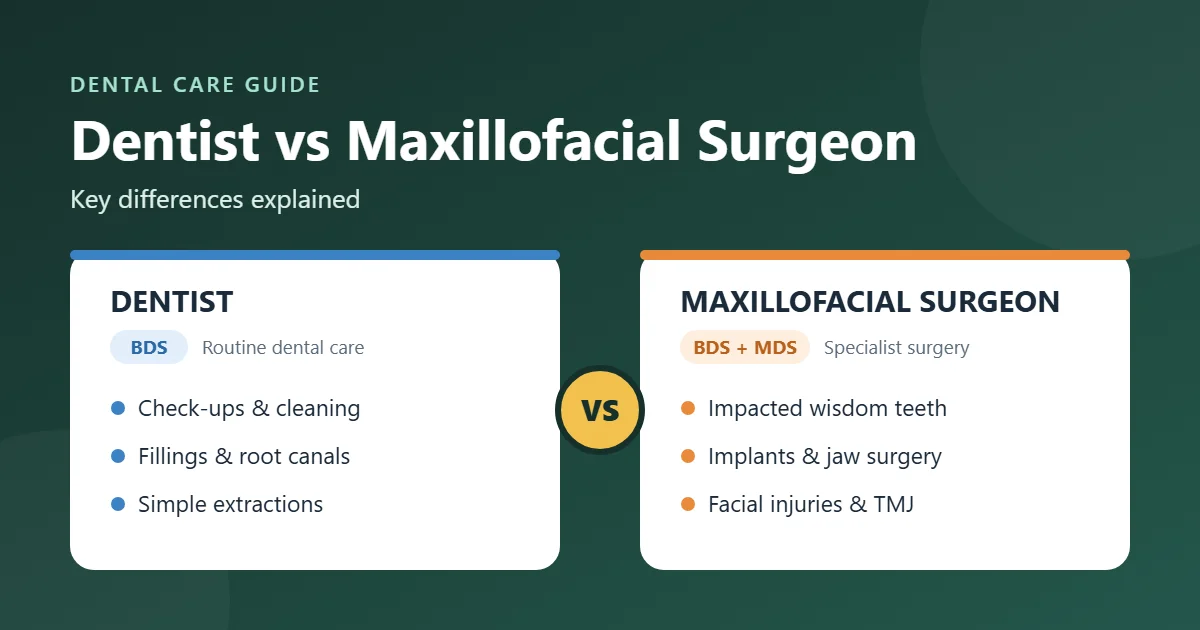
- A dentist provides everyday dental care: check-ups, cleaning, fillings, root canals, crowns, dentures and simple extractions.
- A maxillofacial surgeon performs surgery on the mouth, jaws and face, including impacted wisdom teeth, implants, jaw fractures, corrective jaw surgery, TMJ treatment and tumour removal.
- In India, a dentist holds a BDS degree. A maxillofacial surgeon holds a BDS plus a 3-year MDS in Oral and Maxillofacial Surgery.
- For most dental problems, start with a dentist. They will refer you to a maxillofacial surgeon if surgery is needed.
Dentist vs. Maxillofacial Surgeon at a Glance
| Factor | Dentist | Maxillofacial surgeon |
|---|---|---|
| Qualification in India | BDS (5 years including internship) | BDS + MDS in Oral and Maxillofacial Surgery (3 years) |
| Main focus | Teeth and gums | Teeth, jaws, face, mouth and neck |
| Type of treatment | Preventive and routine dental care | Surgical treatment, simple to complex |
| Where they work | Dental clinics | Clinics, hospitals, trauma centres and cancer centres |
| Anaesthesia | Mostly local anaesthesia | Local anaesthesia, sedation and surgery under general anaesthesia |
| Emergency role | Toothache and dental infections | Facial injuries, jaw fractures and spreading infections |
What Does a Dentist Do?
A dentist, also called a general dentist, is usually your first point of contact for oral health. Their work focuses on preventing, diagnosing and treating common problems of the teeth and gums.
- Routine check-ups and dental X-rays
- Scaling and cleaning
- Fillings for cavities
- Root canal treatment
- Crowns, bridges and dentures
- Simple tooth extractions
- Treatment of gum problems in the early stages
- Advice on brushing, flossing, diet and tobacco use
What Does a Maxillofacial Surgeon Do?
A maxillofacial surgeon, also called an oral and maxillofacial surgeon or OMFS, treats problems that need surgery. Their work goes beyond the teeth to the jawbones, jaw joints, face and neck.
- Removal of impacted or difficult wisdom teeth
- Dental implants and bone grafting
- Repair of jaw and facial fractures after accidents
- Corrective jaw (orthognathic) surgery
- Treatment of TMJ (jaw joint) disorders
- Biopsies of mouth sores, lumps and patches
- Removal of cysts and tumours of the jaws
- Oral cancer surgery and reconstruction
- Drainage of serious facial and neck infections
- Cleft lip and palate repair, as part of a cleft team
Difference in Training
Dentist
In India, a dentist completes a Bachelor of Dental Surgery (BDS), which includes four years of study and a one-year compulsory internship. They must then register with their State Dental Council to practise.
Maxillofacial Surgeon
A maxillofacial surgeon first completes a BDS. They then clear NEET MDS and complete a 3-year Master of Dental Surgery (MDS) in Oral and Maxillofacial Surgery. This training includes surgery, anaesthesia, trauma care, hospital work and management of complex cases. Some go on to do fellowships in areas such as implants, oral cancer, cleft surgery or facial cosmetic surgery.
Can a Dentist Do Surgery?
Yes, but usually minor surgery only. Dentists commonly perform simple extractions and some minor procedures inside the mouth. Some general dentists with extra training also place dental implants.
Complex cases are usually referred to a maxillofacial surgeon. These include deeply impacted wisdom teeth, extensive bone grafting, facial fractures, jaw correction, TMJ surgery and tumours. Maxillofacial surgeons are trained for these procedures and can perform them in a hospital operation theatre when needed.
Which One Should You See?
| Your problem | Who to see first |
|---|---|
| Toothache or sensitivity | Dentist |
| Cavity or broken filling | Dentist |
| Bleeding or swollen gums | Dentist |
| Routine check-up or cleaning | Dentist |
| Painful or impacted wisdom tooth | Dentist or maxillofacial surgeon |
| Missing teeth and dental implants | Dentist or maxillofacial surgeon |
| Jaw or facial injury after an accident | Maxillofacial surgeon or emergency department |
| Misaligned jaws or bite | Orthodontist and maxillofacial surgeon |
| Jaw pain, clicking or locking that won't improve | Maxillofacial surgeon |
| Mouth sore, lump or patch lasting more than 2–3 weeks | Dentist or maxillofacial surgeon promptly |
If you are not sure, start with your dentist. They can treat most problems and refer you to a specialist if needed.
Go to an emergency department immediately if you have rapidly spreading swelling of the face or neck, difficulty breathing or swallowing, heavy bleeding, or a suspected broken jaw.
How Dentists and Maxillofacial Surgeons Work Together
Dentists and maxillofacial surgeons often treat the same patient at different stages. For example:
- Dental implants: the maxillofacial surgeon places the implant and any bone graft, and the dentist later fits the crown, bridge or denture.
- Wisdom teeth: the dentist spots the problem on an X-ray and refers you, and the surgeon removes the tooth.
- Jaw correction: an orthodontist aligns the teeth with braces, and the maxillofacial surgeon repositions the jaws.
- Mouth sores: the dentist notices a suspicious patch during a check-up, and the surgeon performs a biopsy.
Is Treatment by a Maxillofacial Surgeon More Expensive?
Often, yes, because specialist surgery usually involves more training, more complex procedures, and sometimes hospital charges and anaesthesia. However, the cost depends on the procedure, the clinic or hospital, and the city. Always ask for an estimate before treatment.
Frequently Asked Questions
Is a maxillofacial surgeon a dentist?
Yes. Every maxillofacial surgeon is a trained dentist first. They then complete specialist postgraduate training in surgery of the mouth, jaws and face.
Is a maxillofacial surgeon better than a dentist?
Neither is better. They do different jobs. A dentist is the right choice for routine care, while a maxillofacial surgeon is the right choice for complex surgical problems.
Can a dentist remove wisdom teeth?
Yes, a dentist can remove many wisdom teeth, especially simpler ones. Deeply impacted or difficult wisdom teeth are often referred to a maxillofacial surgeon.
Do I need a referral to see a maxillofacial surgeon?
Usually not at private clinics and hospitals in India. Still, seeing your dentist first can help you get the right diagnosis and referral.
Is an oral surgeon the same as a maxillofacial surgeon?
In everyday use, the terms are often used for the same specialist. "Oral and maxillofacial surgeon" is the full title and covers the jaws, face and neck as well as the mouth.
The Bottom Line
A dentist looks after your everyday oral health, from check-ups and fillings to root canals and simple extractions. A maxillofacial surgeon is a dental specialist with extra surgical training who treats complex problems of the teeth, jaws, face and neck. For most issues, start with your dentist. If you need surgery, they will refer you to a maxillofacial surgeon.
Medical disclaimer: This article is for general information only and is not a substitute for professional medical or dental advice. Always consult a qualified dentist or maxillofacial surgeon about your own condition.