
What is the qualification of a maxillofacial surgeon?
- Home
- Blog
A maxillofacial surgeon is a dental specialist trained to perform surgery on the mouth, jaws, face and neck. To become one in India, a person must first become a qualified dentist and then complete specialist postgraduate training in oral and maxillofacial surgery. This guide explains the qualifications step by step, how long the training takes, optional fellowships and how patients can check a surgeon's credentials.
Quick answer
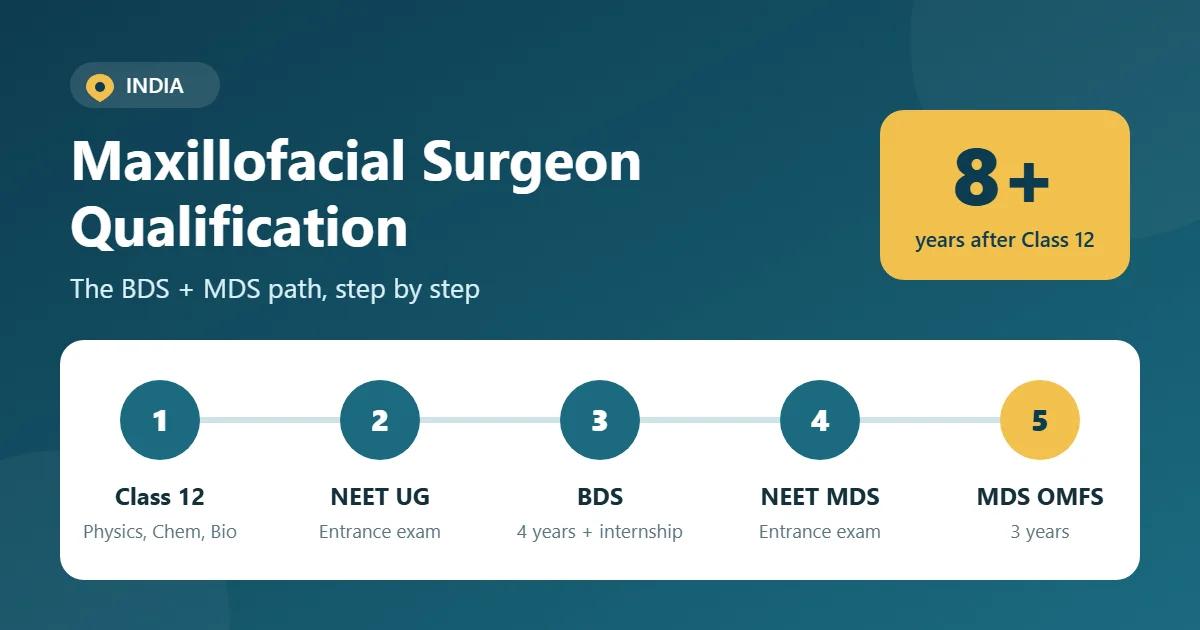
- In India, a maxillofacial surgeon must hold a BDS (Bachelor of Dental Surgery) and an MDS (Master of Dental Surgery) in Oral and Maxillofacial Surgery.
- BDS takes 5 years, including a 1-year internship. MDS takes another 3 years.
- Admission to BDS is through NEET UG, and admission to MDS is through NEET MDS.
- Many surgeons also complete fellowships in areas such as implants, oral cancer, cleft or craniofacial surgery.
- A practising surgeon must be registered with a State Dental Council.
Qualifications at a Glance
| Stage | Qualification | Duration |
|---|---|---|
| School | Class 12 with Physics, Chemistry and Biology | — |
| Entrance exam | NEET UG | — |
| Undergraduate degree | BDS (Bachelor of Dental Surgery) | 4 years + 1-year internship |
| Registration | State Dental Council registration | — |
| Entrance exam | NEET MDS | — |
| Specialist degree | MDS in Oral and Maxillofacial Surgery | 3 years |
| Optional | Fellowships and further training | Usually 1–2 years |
Step-by-Step: How to Become a Maxillofacial Surgeon in India
Step 1: Complete Class 12 With Science
Students need to pass Class 12 with Physics, Chemistry and Biology, and English, with the minimum marks required for dental admission.
Step 2: Qualify NEET UG
Admission to BDS courses across India is through the National Eligibility cum Entrance Test (NEET UG), the same exam used for MBBS admissions.
Step 3: Complete BDS
The Bachelor of Dental Surgery (BDS) is a 5-year course: 4 years of academic and clinical study followed by a 1-year compulsory rotating internship. During BDS, students study general medical subjects as well as all branches of dentistry, including oral surgery.
Step 4: Register With the State Dental Council
After BDS, graduates register with their State Dental Council. This allows them to practise as a general dentist.
Step 5: Qualify NEET MDS
To specialise, dentists must clear NEET MDS, the national entrance exam for postgraduate dental courses. Candidates need a recognised BDS degree and must have completed their internship by the cut-off date set for the exam.
Step 6: Complete MDS in Oral and Maxillofacial Surgery
The MDS in Oral and Maxillofacial Surgery is a 3-year full-time course. It trains dentists to diagnose and surgically manage problems of the mouth, jaws, face and neck. Training usually covers:
- Surgical removal of impacted teeth
- Dental implants and bone grafting
- Facial trauma and fracture management
- Corrective jaw (orthognathic) surgery
- TMJ (jaw joint) disorders
- Cysts, tumours and oral cancer
- Cleft lip and palate
- Head and neck infections
- Anaesthesia, sedation and emergency care
- Hospital and ward care, including work in operation theatres
Students also complete a thesis (dissertation) and pass final university examinations.
Step 7: Optional Fellowships and Further Training
After MDS, many surgeons go on to gain extra skills through fellowships or advanced courses in India or abroad. Common areas include:
- Implantology
- Head and neck oncology
- Cleft and craniofacial surgery
- Facial cosmetic and aesthetic surgery
- TMJ surgery
- Microvascular reconstruction
Some surgeons also earn international qualifications, such as fellowships from the Royal Colleges of Surgeons in the UK.
How Long Does It Take?
From the end of Class 12, it usually takes at least 8 years to become a maxillofacial surgeon in India: 5 years for BDS (including internship) and 3 years for MDS. It often takes longer if there is a gap while preparing for NEET MDS, or if the surgeon does a fellowship.
Regulatory Bodies in India
- Dental education regulator: dental education has been regulated by the Dental Council of India (DCI), which is being replaced by the National Dental Commission under the National Dental Commission Act, 2023. Courses must be recognised by the national regulator.
- State Dental Councils: register dentists and specialists to practise in each state.
- National Board of Examinations in Medical Sciences (NBEMS): conducts NEET MDS.
- Association of Oral and Maxillofacial Surgeons of India (AOMSI): the professional association for the specialty. Membership is not required, but many surgeons are members.
Do Maxillofacial Surgeons Need an MBBS Degree?
Not in India. An MDS in Oral and Maxillofacial Surgery is enough to practise as a specialist. Some surgeons choose to also complete MBBS, especially if they want to work in countries where both degrees are required.
Qualifications in Other Countries
| Country | Typical requirement |
|---|---|
| India | BDS + MDS in Oral and Maxillofacial Surgery |
| United Kingdom | Both a dental and a medical degree, followed by surgical specialty training |
| United States | A dental degree (DDS or DMD) plus a 4–6 year hospital residency; some programmes include a medical degree |
| Many European countries | Often both dental and medical degrees, depending on the country |
Requirements vary and can change, so check with the relevant regulator in each country.
Skills a Good Maxillofacial Surgeon Needs
- Precise surgical and hand skills
- A detailed knowledge of the anatomy of the head and neck
- Good judgement in emergencies
- The ability to plan treatment using X-rays and 3D scans
- Teamwork with dentists, orthodontists, ENT surgeons, plastic surgeons and cancer specialists
- Clear communication with patients
How Patients Can Check a Maxillofacial Surgeon's Qualifications
- Ask whether the surgeon holds an MDS in Oral and Maxillofacial Surgery, not only a BDS.
- Ask for their State Dental Council registration number, and check it with the council if you can.
- Ask about any fellowships that relate to your treatment, such as implants or jaw surgery.
- Ask how much experience they have with your specific procedure.
- Check whether they operate in a hospital with proper facilities for major surgery.
Frequently Asked Questions
What degree does a maxillofacial surgeon have?
In India, a maxillofacial surgeon has a BDS degree and an MDS in Oral and Maxillofacial Surgery.
Can a BDS dentist call themselves a maxillofacial surgeon?
No. A BDS dentist can perform routine dental care and minor oral surgery, but the title of maxillofacial surgeon requires a recognised MDS in Oral and Maxillofacial Surgery.
Is MDS in Oral and Maxillofacial Surgery hard to get?
Yes, it is competitive. Admission depends on your NEET MDS rank, and oral and maxillofacial surgery is one of the popular MDS branches.
Can MBBS doctors become maxillofacial surgeons in India?
Not directly. MDS in Oral and Maxillofacial Surgery requires a BDS degree. MBBS doctors can work in related fields, such as plastic surgery, ENT or head and neck oncology.
How many years does it take to become a maxillofacial surgeon?
At least 8 years after Class 12 in India: 5 years for BDS and 3 years for MDS. Fellowships add more time.
The Bottom Line
A maxillofacial surgeon in India must complete a BDS, register with a State Dental Council, clear NEET MDS and finish a 3-year MDS in Oral and Maxillofacial Surgery. Many also pursue fellowships for advanced skills. If you need surgery, always check that your surgeon holds the right MDS qualification, valid registration and experience in your procedure.
Disclaimer: This article is for general information only. Eligibility rules, course durations and regulations can change. Always check the latest official notifications from NBEMS, the national dental regulator and your State Dental Council.