
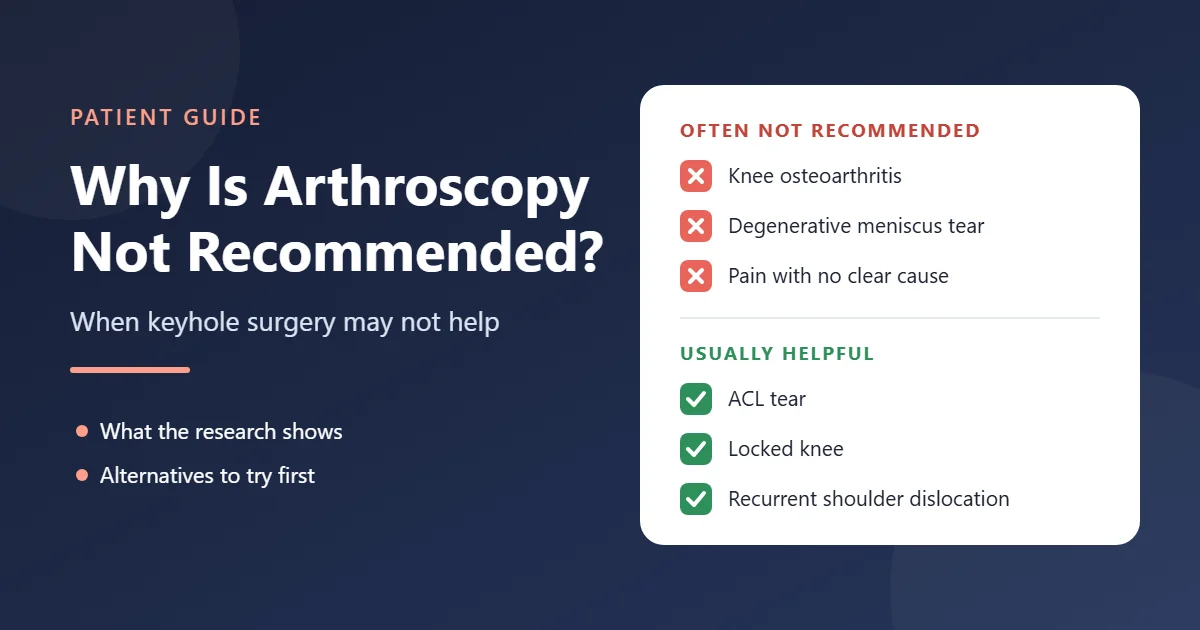
Why is arthroscopy not recommended?
- Home
- Blog
Arthroscopy, or keyhole surgery, can be very helpful for some joint problems. But it is not the right treatment for everyone. In some common conditions, especially wear-and-tear knee pain, research shows that arthroscopy often works no better than physiotherapy or other non-surgical care. This guide explains when arthroscopy is not recommended, why, and what alternatives may help.
Quick answer
- Arthroscopy is generally not recommended for knee pain caused by osteoarthritis or most degenerative (age-related) meniscus tears.
- Several high-quality studies found it gave little or no long-term benefit over non-surgical treatment for these problems.
- It may also be unsuitable when a joint needs a different operation, when non-surgical care has not been tried, or when health risks are too high.
- Arthroscopy is still useful for many conditions, such as ACL tears, a locked knee and recurrent shoulder dislocation.
Arthroscopy Is Useful, but Not for Every Problem
Arthroscopy lets a surgeon look inside a joint and treat it through small cuts. It works well when there is a clear mechanical problem that can be fixed, such as a torn ligament, a loose piece of cartilage, or an unstable shoulder.
The problem is that arthroscopy was once widely used for general joint pain, especially in older adults with knee arthritis. Over time, research showed that many of these patients did not benefit as much as expected. As a result, doctors and medical guidelines now recommend it more selectively.
Conditions Where Arthroscopy Is Usually Not Recommended
1. Knee Osteoarthritis
Osteoarthritis is wear-and-tear damage to the joint cartilage. In the past, surgeons often used arthroscopy to wash out the knee (lavage) or smooth rough cartilage (debridement).
Studies comparing these procedures with placebo (sham) surgery or non-surgical care found little lasting benefit. Many clinical guidelines, including guidance from the UK's National Institute for Health and Care Excellence (NICE), now advise against routinely using arthroscopic lavage and debridement to treat osteoarthritis.
2. Degenerative Meniscus Tears
As people age, the meniscus (the knee's shock-absorbing cartilage) can develop small tears without any major injury. These degenerative tears are very common on MRI scans, even in people who have no knee pain.
Research, including trials that compared arthroscopic partial meniscectomy with sham surgery, found similar results in both groups for many patients. A 2017 clinical practice guideline published in The BMJ made a strong recommendation against arthroscopic surgery for most people with degenerative knee disease, including degenerative meniscus tears.
3. Some Cases of Shoulder Impingement
Arthroscopic subacromial decompression was once a common operation for shoulder pain caused by impingement. Large trials have found that, for many patients, it gives little extra benefit compared with diagnostic arthroscopy alone or with structured physiotherapy. Many surgeons now recommend exercise-based treatment first.
4. Pain Without a Clear Mechanical Cause
If imaging and examination do not show a specific problem that surgery can fix, arthroscopy is unlikely to help. Pain can come from many sources, including inflammation, muscle weakness, nerve problems or pain from a nearby joint.
Why Arthroscopy May Not Be Recommended for You
Non-Surgical Treatment Has Not Been Tried
Many joint problems improve with physiotherapy, weight management, activity changes, medicines or injections. Surgery is usually considered only when these have been tried properly and have not helped enough.
The Joint Needs a Different Operation
When arthritis is advanced, arthroscopy cannot repair worn-out cartilage. A procedure such as a partial or total joint replacement, or an osteotomy (realigning the bone), may be more suitable.
The Risks Outweigh the Benefits
Arthroscopy is generally low risk, but complications such as infection, blood clots and stiffness can happen. If the expected benefit is small, even a low risk may not be worth it.
Your Health Makes Surgery Unsafe
Surgery may be postponed or avoided if you have:
- An active infection, especially near the joint
- Serious heart or lung disease that makes anaesthesia risky
- Poorly controlled diabetes
- A bleeding or clotting disorder that has not been managed
- A recent blood clot
Open Surgery Is a Better Option
Some injuries, complex fractures or large repairs need more access than arthroscopy can provide. In these cases, open surgery may give a better and safer result.
When Arthroscopy Is Still Recommended
Arthroscopy remains a valuable treatment for many problems, including:
- ACL and other ligament reconstructions
- A knee that locks or cannot fully straighten because of a torn meniscus fragment or loose body
- Repairable meniscus tears, especially in younger, active people
- Recurrent shoulder dislocation
- Some rotator cuff tears
- Some hip, ankle, elbow and wrist problems
- Joint infection that needs washing out
- Certain jaw joint (TMJ) problems that have not improved with non-surgical treatment
Arthroscopy: Usually Helpful vs. Usually Not Recommended
| Usually helpful | Usually not recommended |
|---|---|
| ACL tear in an active person | Knee pain mainly due to osteoarthritis |
| Locked knee from a torn meniscus fragment | Degenerative meniscus tear without locking |
| Recurrent shoulder dislocation | Many cases of shoulder impingement pain |
| Loose bodies inside a joint | Joint pain with no clear mechanical cause |
| Joint infection needing washout | Advanced arthritis needing joint replacement |
Every patient is different. This table is a general guide only, and your surgeon will consider your symptoms, examination, scans and goals.
Alternatives to Arthroscopy
- Physiotherapy: strengthening and movement exercises are a key treatment for knee arthritis, degenerative meniscus tears and many shoulder problems.
- Weight management: losing extra weight can reduce pressure on the knees and hips.
- Activity changes: adjusting how and how much you exercise can ease symptoms.
- Medicines: pain relievers or anti-inflammatory medicines, if safe for you.
- Injections: such as steroid injections, which may give short-term relief in some conditions.
- Supports: braces, insoles or walking aids.
- Other surgery: joint replacement or osteotomy for advanced arthritis.
Questions to Ask Before Agreeing to Arthroscopy
- What exactly is causing my pain?
- Is this a problem arthroscopy can fix?
- What does the research say about arthroscopy for my condition?
- Have I tried enough non-surgical treatment first?
- What will happen if I don't have surgery?
- What are the risks, and how long is recovery?
- Should I get a second opinion?
Frequently Asked Questions
Why do doctors no longer recommend arthroscopy for knee arthritis?
High-quality studies found that washing out or smoothing an arthritic knee usually gave little lasting benefit compared with non-surgical treatment or placebo surgery. It does not repair worn cartilage.
Is arthroscopy bad for older adults?
Not necessarily. Age alone is not the issue. The main question is whether there is a specific problem arthroscopy can fix. Older adults more often have arthritis or degenerative tears, which usually do not respond well to arthroscopy.
Should I have surgery for a meniscus tear seen on MRI?
Not always. Degenerative meniscus tears are common and often cause no symptoms. Many improve with physiotherapy. Surgery may be considered for a locked knee or a repairable tear, especially after an injury in a younger person.
Is arthroscopy a waste of money?
No, when it is used for the right problem. It can be very effective for ligament tears, mechanical locking and recurrent dislocation. It is less likely to help when the main problem is arthritis or age-related wear.
The Bottom Line
Arthroscopy is a useful tool, but it is not a cure for every type of joint pain. It is usually not recommended for knee osteoarthritis, most degenerative meniscus tears, or pain without a clear mechanical cause. In these cases, physiotherapy and other non-surgical treatments often work just as well with fewer risks. If surgery has been suggested, ask what problem it will fix, what the evidence shows, and whether you have tried other options first.
Medical disclaimer: This article is for general information only and is not a substitute for professional medical advice. Talk to a qualified orthopaedic surgeon about your own condition and treatment options.