
TMJ arthroscopy scar
- Home
- Blog
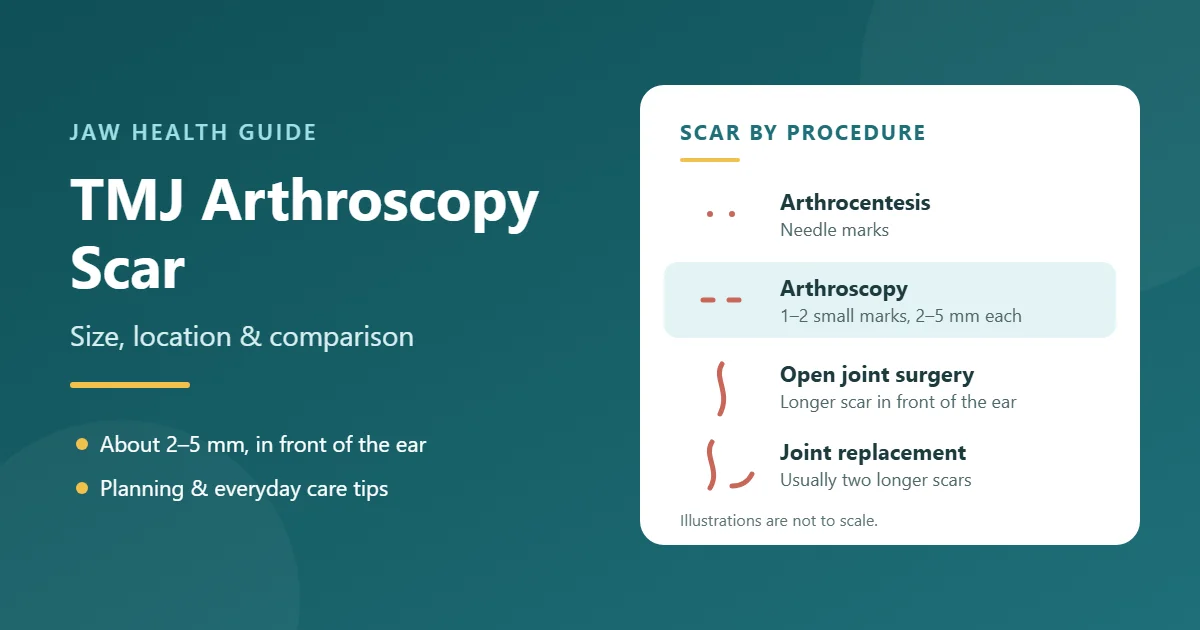
A TMJ arthroscopy scar is usually very small. Most people have one or two marks, each about 2–5 mm long, just in front of the ear. If you are comparing TMJ procedures or worried about a visible mark on your face, this guide explains where the scar sits, how it compares with other TMJ surgery scars and what you can do before and after surgery to keep it as discreet as possible.
Quick answer
- Size: about 2–5 mm for each opening
- Number: usually one or two on each treated side
- Location: in front of the ear, often close to a natural skin crease
- Visibility: often hard to notice within 6–12 months
- Compared with open TMJ surgery: much smaller
Where Is the TMJ Arthroscopy Scar?
The jaw joint sits just in front of the ear, so this is where the surgeon makes the openings. One opening is used for the camera. A second may be needed for fluid drainage or instruments. If both jaw joints are treated, there will be small marks on both sides of the face.
Natural skin lines, sideburns, hair and the shape of the ear can all help to hide the area.
TMJ Scar Comparison by Procedure
| Procedure | Typical mark or scar |
|---|---|
| TMJ injection | Tiny needle mark that usually leaves no visible scar |
| Arthrocentesis | One or two needle marks that usually leave no visible scar |
| Arthroscopy | One or two small marks, about 2–5 mm each |
| Open joint surgery | A longer scar in front of the ear, sometimes extending into the hairline |
| Total joint replacement | Usually a scar in front of the ear and another below or behind the jaw |
A smaller scar does not automatically make a procedure the right choice. Your diagnosis and the condition of your joint matter more.
How Are the Openings Closed?
The openings may be closed with a small stitch, adhesive strips or skin glue. Sometimes a very small puncture needs only a dressing. Your surgeon will tell you whether a stitch needs to be removed and when you can wash the area.
What Affects How Your Scar Looks?
- Skin type and family history: some people are more likely to form raised scars or keloids.
- Skin tone: darker skin may be more prone to keloids and to darkening around a healing wound.
- Infection: an infected wound may leave a more noticeable mark.
- Sun exposure: sunlight can darken a new scar.
- Smoking: it can slow wound healing.
- Picking or rubbing: disturbing the wound can affect healing.
Before Surgery: How to Plan for a Discreet Scar
- Tell your surgeon if you have had a keloid or raised scar before.
- Ask exactly where the openings will be and how many are planned.
- Ask whether the procedure might need to change to open surgery.
- Stop smoking as early as possible.
- Tell your surgeon about any skin infection or irritation near the ear.
- If you have an important event coming up, ask about timing, because early redness and swelling are normal.
Everyday Care After Surgery
Shaving
Don't shave directly over the openings until they have fully healed and your surgeon agrees.
Make-Up
Wait until the skin is completely closed, with no scab or discharge. Use clean products and remove them gently.
Hair Products and Colour
Keep sprays, dyes and other chemicals away from the healing wounds.
Glasses, Masks and Earphones
Avoid anything that rubs or presses on the area. If your glasses or mask touch the wound, ask your surgeon how to protect it.
Sun Protection
Once the wound has healed, use a broad-spectrum sunscreen of SPF 30 or higher for at least 6–12 months. A hat or scarf also helps.
Silicone and Massage
Silicone gel and gentle massage may be recommended after the wound has fully closed. Ask your surgeon before you start either one.
Can a Noticeable Scar Be Treated?
Most arthroscopy scars need no treatment. If a scar becomes raised, dark or itchy, options may include silicone, steroid injections, laser treatment or, rarely, scar revision. A dermatologist or your surgeon can advise you. Early advice is especially useful if you are prone to keloids.
When to Contact Your Surgeon
- Increasing redness, warmth or pain around the wound
- Pus, a bad smell or fever
- The wound opens or bleeding does not stop
- The scar becomes thicker, larger or more itchy over time
- You notice facial weakness or difficulty closing your eye
Frequently Asked Questions
How big is a TMJ arthroscopy scar?
Each scar is usually about 2–5 mm. Most people have one or two on each treated side.
Will people notice my scar?
It may look pink at first, but it is often hard to notice within 6–12 months.
Is the scar inside the ear?
The openings are usually in the skin in front of the ear, not inside the ear canal.
Can I cover the scar with make-up?
Yes, once the skin has fully healed and your surgeon agrees.
Is an arthroscopy scar smaller than an open surgery scar?
Yes. Arthroscopy uses tiny openings, while open TMJ surgery needs a longer incision.
The Bottom Line
A TMJ arthroscopy scar is usually only a few millimetres long and sits in front of the ear. It is much smaller than an open surgery scar and often becomes hard to see with time. Share any history of keloids before surgery, protect the healing skin and contact your surgeon if the scar or wound changes unexpectedly.
Medical disclaimer: This article is for general information only and is not a substitute for professional medical advice. Always follow your surgeon's instructions about wound and scar care.
If your doctor has suggested TMJ arthroscopy for jaw pain, clicking or locking, it is natural to worry about how painful it will be. The good news is that TMJ arthroscopy is a minimally invasive procedure, and you should not feel pain during it. Most people have mild to moderate soreness for a few days afterwards, which is usually well controlled with medicines, ice and rest. This guide explains what the pain feels like, how long it lasts and how to stay comfortable during recovery.
Quick answer
- You should not feel pain during TMJ arthroscopy. It is usually done under general anaesthesia, or sometimes under local anaesthesia with sedation.
- Afterwards, most people have mild to moderate soreness, swelling and jaw stiffness in front of the ear.
- Discomfort is usually worst in the first 2–3 days and improves noticeably within about a week.
- Pain is generally less than after open jaw joint surgery, because only one or two tiny incisions are made.
- Painkillers, ice packs, a soft diet and gentle jaw exercises help most people recover comfortably.
What Is TMJ Arthroscopy?
The temporomandibular joint (TMJ) connects your lower jaw to your skull, just in front of each ear. In TMJ arthroscopy, an oral and maxillofacial surgeon inserts a very thin camera into the joint through a small puncture, usually 2–5 mm wide. Through this and sometimes one more small opening, the surgeon can wash out the joint, release adhesions, remove inflamed tissue or reposition the disc.
Because the openings are so small, there is much less tissue damage than with open joint surgery. This is the main reason the pain afterwards is usually manageable.
Is TMJ Arthroscopy Painful During the Procedure?
No. You should not feel pain during the procedure.
- General anaesthesia: most commonly used. You are fully asleep and feel nothing.
- Local anaesthesia with sedation: sometimes used for shorter procedures. The area is numbed, and you are relaxed and drowsy. You may feel some pressure or movement, but not sharp pain.
A long-acting local anaesthetic is often injected into the area during surgery, so the joint stays numb for several hours after you wake up.
What Does the Pain Feel Like After Surgery?
Most people describe the feeling as a dull ache or soreness rather than sharp pain. Common sensations include:
- Aching or tenderness in front of the ear
- Swelling on the side of the face
- Jaw stiffness and difficulty opening the mouth fully
- A blocked or full feeling in the ear
- Your back teeth not meeting properly on the operated side for a few days, caused by swelling in the joint
- Mild headache or tiredness after anaesthesia
- Slight numbness of the skin near the incision
These effects are normal and usually settle as the swelling goes down.
TMJ Arthroscopy Pain Timeline
| Time after surgery | What you may feel |
|---|---|
| First 24 hours | The area may stay numb at first. Soreness begins as the anaesthetic wears off. Swelling starts to appear. |
| Days 2–3 | Discomfort and swelling are usually at their peak. Jaw stiffness and an ear-fullness feeling are common. |
| Days 4–7 | Pain steadily eases. Many people need fewer painkillers and can return to light work or study. |
| Weeks 2–4 | Mild ache or tiredness in the jaw after chewing or talking. Mouth opening improves with exercises. |
| 1–3 months | The joint continues to heal. Most people notice less jaw pain than they had before surgery. |
Everyone heals differently. Your recovery depends on your condition, what was done inside the joint and how closely you follow aftercare advice.
How Pain After TMJ Arthroscopy Is Managed
Medicines
Your surgeon will usually prescribe painkillers, often paracetamol and an anti-inflammatory medicine, if these are safe for you. Stronger pain relief may be given for the first day or two if needed. Take medicines exactly as prescribed, and don't combine them with other painkillers without medical advice.
Cold and Warm Packs
- First 48 hours: apply a cold pack wrapped in a cloth to the side of the face for 15–20 minutes at a time to reduce swelling.
- After 48 hours: your surgeon may recommend warm compresses to relax the muscles and ease stiffness.
Soft Diet
Eat soft foods such as khichdi, dal, curd, soups, mashed vegetables, eggs and smoothies for the period your surgeon advises, often 1–2 weeks. Avoid hard, chewy and crunchy foods, and cut food into small pieces.
Jaw Rest and Exercises
- Avoid opening your mouth very wide, chewing gum and biting on hard objects.
- Try to support your jaw when you yawn.
- Start the gentle jaw exercises or physiotherapy your surgeon recommends. They help reduce stiffness and prevent scar tissue inside the joint.
Rest and Sleep
Sleep with your head slightly raised for the first few nights to help reduce swelling. Try not to sleep on the operated side at first.
Is TMJ Arthroscopy Less Painful Than Open Jaw Surgery?
| Factor | TMJ arthroscopy | Open TMJ surgery |
|---|---|---|
| Incision | 1–2 tiny punctures | Longer incision in front of the ear |
| Pain after surgery | Usually mild to moderate | Usually more |
| Swelling | Usually less | Usually more |
| Hospital stay | Often same day or one night | Usually longer |
| Return to daily activities | Often within about a week | Usually takes longer |
What Can Make Recovery More Painful?
- Chewing hard food too early
- Opening the mouth too wide or talking for long periods in the first few days
- Teeth grinding or clenching, especially at night
- Skipping prescribed medicines or jaw exercises
- Stress, which can increase jaw muscle tension
- Long-standing jaw pain before surgery, which may take longer to settle
If you grind your teeth, ask your dentist or surgeon whether a night guard may help.
When to Contact Your Surgeon
Call your surgeon promptly if you have:
- Pain that gets worse after the first few days instead of better
- Pain that is not controlled by your prescribed medicines
- Fever, increasing redness, warmth or pus from the incision
- Swelling that keeps increasing after day 3
- Weakness of the face, such as difficulty raising your eyebrow or closing your eye
- Hearing loss, ear discharge or severe ear pain
- Your teeth still not meeting properly after the first week
Seek emergency care if you have difficulty breathing or swallowing, or swelling that spreads rapidly.
Frequently Asked Questions
How painful is TMJ arthroscopy on a scale of 1 to 10?
Pain is personal, so there is no single number. Most people describe it as mild to moderate soreness for the first few days, which becomes much easier to manage within about a week with medicines and rest.
How long does pain last after TMJ arthroscopy?
Discomfort usually peaks in the first 2–3 days and improves within about a week. Mild aching after eating or talking may continue for a few weeks.
Will I be able to eat after TMJ arthroscopy?
Yes. You can usually start with liquids and soft foods on the same day or the next day. Your surgeon will tell you when you can return to a normal diet.
When can I go back to work after TMJ arthroscopy?
Many people return to desk work or study within about 3–7 days. If your job involves a lot of talking or physical effort, you may need a little longer.
Does TMJ arthroscopy leave a scar?
It leaves one or two tiny marks in front of the ear, which usually fade to faint dots within 6–12 months.
Is the pain worth it?
For many patients whose jaw pain or locking hasn't improved with splints, medicines and physiotherapy, TMJ arthroscopy can reduce pain and improve mouth opening. Ask your surgeon about the expected benefit for your specific condition.
The Bottom Line
TMJ arthroscopy is not painful during the procedure, because you are under anaesthesia. Afterwards, most people have mild to moderate soreness, swelling and stiffness for a few days, which improves steadily over the first week. Painkillers, cold packs, a soft diet and gentle jaw exercises make recovery much more comfortable. If your pain gets worse instead of better, or you notice any warning signs, contact your surgeon promptly.
Medical disclaimer: This article is for general information only and is not a substitute for professional medical advice. Always follow the instructions of your oral and maxillofacial surgeon about pain relief and recovery.