
Arthroscopy for temporomandibular joint disorders
- Home
- Blog
Arthroscopy for temporomandibular joint (TMJ) disorders is a minimally invasive procedure that lets a surgeon see inside the jaw joint and treat certain problems through tiny openings. It may be considered for jaw pain, locking or limited mouth opening that comes from inside the joint and has not improved with non-surgical care. Most people with a TMJ disorder do not need surgery.
Quick answer
- TMJ arthroscopy can be used to examine, wash out and treat the jaw joint.
- It is mainly considered when a problem inside the joint continues despite non-surgical treatment.
- It is usually done under general anaesthesia through one or two openings of about 2–5 mm.
- Many people return to desk work within 3–7 days, while fuller recovery may take 1–3 months or longer.
- It is not usually the right treatment for jaw pain that comes mainly from the muscles.
What Are Temporomandibular Joint Disorders?
The temporomandibular joints connect your lower jaw to your skull, one in front of each ear. They help you chew, talk and yawn. A small disc inside each joint cushions the movement between the bones.
Temporomandibular disorders, often shortened to TMD, are a group of problems that affect these joints, the jaw muscles or both. Common symptoms include:
- Pain in the jaw, face or in front of the ear
- Clicking, popping or grating in the joint
- The jaw getting stuck open or closed
- Difficulty opening the mouth
- Pain when chewing
- Headache or ear discomfort
Painless clicking on its own usually does not need surgery.
Which TMJ Problems May Be Treated With Arthroscopy?
- Disc displacement: the disc has moved out of its normal position, causing pain or locking.
- Closed lock: the mouth cannot open fully because of a problem inside the joint.
- Adhesions: bands of scar-like tissue limit joint movement.
- Synovitis: the lining of the joint is inflamed.
- Some arthritis: joint wear or inflammatory arthritis is causing symptoms.
- Some cases of repeated dislocation: the jaw slips out of place again and again.
- Diagnosis or biopsy: the cause remains unclear and the surgeon needs to see or sample tissue.
When Is TMJ Arthroscopy Considered?
Your surgeon may discuss arthroscopy when:
- Your symptoms affect eating, talking or daily life
- Examination and scans suggest a problem inside the joint
- Non-surgical care has not helped enough
- The likely benefit is greater than the risk
Non-surgical care may include education, jaw rest, a soft diet, physiotherapy, a splint, medicines and help with clenching or stress.
When May Arthroscopy Not Be Suitable?
- Pain mainly from the jaw muscles
- Bony fusion of the joint (bony ankylosis)
- An active skin or ear infection near the joint
- Severe joint damage that needs open surgery or joint replacement
- Medical problems that make anaesthesia or surgery unsafe
How Is the Problem Diagnosed?
- History: your symptoms, injuries, habits and previous treatment.
- Examination: mouth opening, joint sounds, tenderness, jaw muscles and bite.
- Imaging: an OPG X-ray for an overview, MRI to assess the disc and soft tissue, or CT/CBCT to assess bone.
- Other tests: blood tests if inflammatory arthritis is suspected, or a numbing injection to help find the source of pain.
Types of TMJ Arthroscopy
| Type | What it involves |
|---|---|
| Diagnostic arthroscopy | Looking inside the joint to find the problem |
| Lysis and lavage | Releasing adhesions and washing out the joint |
| Operative arthroscopy | Treating inflamed or damaged tissue, or taking a biopsy |
| Arthroscopic discopexy | Repositioning the disc and securing it |
More advanced techniques need extra equipment and specialist experience.
What Happens During the Procedure?
- You are usually given general anaesthesia.
- The surgeon cleans the skin and marks the area in front of the ear.
- Fluid is placed into the joint to create space.
- A thin camera is passed through a small opening.
- A second opening may be used for drainage or instruments.
- The surgeon examines, washes and treats the joint.
- The jaw is moved gently to check its range of movement.
- The openings are closed with a stitch, strips, glue or a dressing.
The time needed depends on the technique and whether one or both joints are treated.
Possible Benefits
- Less jaw pain
- Better mouth opening
- Less locking
- Easier chewing
- Smaller scars and usually a shorter recovery than open surgery
Results vary, and no surgeon can guarantee complete relief.
Risks and Complications
- Swelling, bruising and temporary stiffness
- A temporary change in your bite
- Bleeding or infection
- Numbness near the ear
- Weakness of part of the face, which is usually temporary
- Ear injury or changes in hearing
- Damage inside the joint or instrument breakage, which is rare
- Continuing symptoms or the need for another procedure
- Risks related to anaesthesia
Recovery After TMJ Arthroscopy
| Time | What to expect |
|---|---|
| Days 1–3 | Soreness, swelling and stiffness are usually at their worst |
| Days 3–7 | Many people return to desk work or study |
| Weeks 1–2 | Wounds heal and most people continue a soft diet |
| Months 1–3 | Comfort and jaw movement continue to improve |
Jaw exercises or physiotherapy help prevent stiffness. Follow the programme your surgeon gives you, because recovery differs by procedure.
Arthroscopy vs. Other TMJ Treatments
| Treatment | What it is | When it may be used |
|---|---|---|
| Non-surgical care | Exercises, splints, medicines and habit changes | First step for most people |
| Injection | Medicine placed into the joint or muscles | Selected joint or muscle problems |
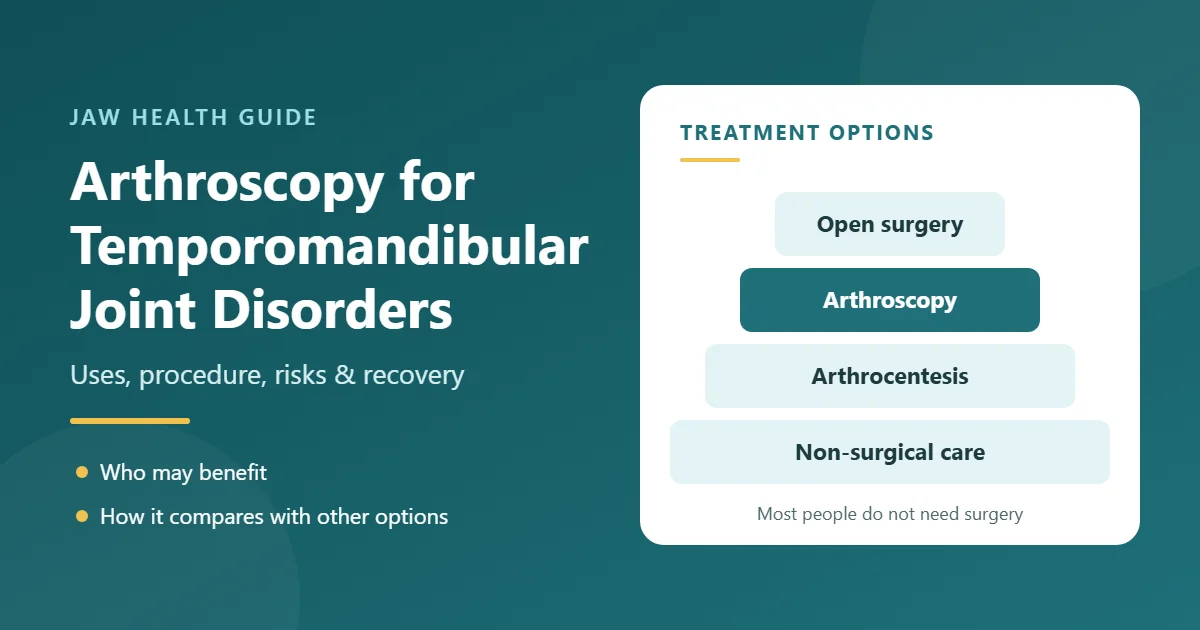
| Arthrocentesis | Washing the joint using needles, without a camera | Some pain or locking problems |
| Arthroscopy | Seeing and treating the joint with a camera | Problems inside the joint that have not improved enough |
| Open surgery | Operating through a longer incision | Problems that cannot be treated through small openings |
| Joint replacement | Replacing the damaged joint | Severe, end-stage joint damage |
Arthrocentesis is simpler, while arthroscopy lets the surgeon see and treat the joint directly. Studies comparing the two have shown mixed results, so the best option depends on your diagnosis.
Questions to Ask Your Surgeon
- Is my pain coming from the joint, the muscles or both?
- Have I tried enough non-surgical treatment?
- Would arthrocentesis be suitable for me?
- Which type of arthroscopy do you recommend, and why?
- How many of these procedures have you performed?
- What result can I realistically expect?
- What happens if it does not work?
When to Seek Urgent Help
Go to an emergency department if your jaw is stuck open, you have difficulty breathing or swallowing, or you have rapidly spreading swelling. After surgery, contact your surgeon promptly for fever, pus, increasing pain, hearing loss or facial weakness.
Jaw pain can sometimes be a sign of a heart problem. Get emergency help if it comes with chest pain, breathlessness, sweating, or pain spreading to the arm.
Frequently Asked Questions
Does TMJ disorder always need surgery?
No. Most people are managed without surgery.
Can arthroscopy cure TMJ disorder?
It can reduce pain and improve movement for some people, but symptoms may continue or return.
Is TMJ arthroscopy a major surgery?
It is minimally invasive, but it is still surgery and usually needs general anaesthesia.
Will my jaw stop clicking?
Not always. The main aims are usually to reduce pain and improve function, so some clicking may remain.
Who performs TMJ arthroscopy?
It is usually performed by an oral and maxillofacial surgeon with training in jaw joint procedures.
The Bottom Line
Arthroscopy can help selected people with TMJ disorders when the problem is inside the joint and non-surgical care has not been enough. It offers a direct view of the joint through tiny openings and usually has a shorter recovery than open surgery. A careful diagnosis is the most important step before choosing it.
Medical disclaimer: This article is for general information only and is not a substitute for professional medical advice. Consult a qualified oral and maxillofacial surgeon about your own condition.
If your doctor has suggested TMJ arthroscopy for jaw pain, clicking or locking, it is natural to worry about how painful it will be. The good news is that TMJ arthroscopy is a minimally invasive procedure, and you should not feel pain during it. Most people have mild to moderate soreness for a few days afterwards, which is usually well controlled with medicines, ice and rest. This guide explains what the pain feels like, how long it lasts and how to stay comfortable during recovery.
Quick answer
- You should not feel pain during TMJ arthroscopy. It is usually done under general anaesthesia, or sometimes under local anaesthesia with sedation.
- Afterwards, most people have mild to moderate soreness, swelling and jaw stiffness in front of the ear.
- Discomfort is usually worst in the first 2–3 days and improves noticeably within about a week.
- Pain is generally less than after open jaw joint surgery, because only one or two tiny incisions are made.
- Painkillers, ice packs, a soft diet and gentle jaw exercises help most people recover comfortably.
What Is TMJ Arthroscopy?
The temporomandibular joint (TMJ) connects your lower jaw to your skull, just in front of each ear. In TMJ arthroscopy, an oral and maxillofacial surgeon inserts a very thin camera into the joint through a small puncture, usually 2–5 mm wide. Through this and sometimes one more small opening, the surgeon can wash out the joint, release adhesions, remove inflamed tissue or reposition the disc.
Because the openings are so small, there is much less tissue damage than with open joint surgery. This is the main reason the pain afterwards is usually manageable.
Is TMJ Arthroscopy Painful During the Procedure?
No. You should not feel pain during the procedure.
- General anaesthesia: most commonly used. You are fully asleep and feel nothing.
- Local anaesthesia with sedation: sometimes used for shorter procedures. The area is numbed, and you are relaxed and drowsy. You may feel some pressure or movement, but not sharp pain.
A long-acting local anaesthetic is often injected into the area during surgery, so the joint stays numb for several hours after you wake up.
What Does the Pain Feel Like After Surgery?
Most people describe the feeling as a dull ache or soreness rather than sharp pain. Common sensations include:
- Aching or tenderness in front of the ear
- Swelling on the side of the face
- Jaw stiffness and difficulty opening the mouth fully
- A blocked or full feeling in the ear
- Your back teeth not meeting properly on the operated side for a few days, caused by swelling in the joint
- Mild headache or tiredness after anaesthesia
- Slight numbness of the skin near the incision
These effects are normal and usually settle as the swelling goes down.
TMJ Arthroscopy Pain Timeline
| Time after surgery | What you may feel |
|---|---|
| First 24 hours | The area may stay numb at first. Soreness begins as the anaesthetic wears off. Swelling starts to appear. |
| Days 2–3 | Discomfort and swelling are usually at their peak. Jaw stiffness and an ear-fullness feeling are common. |
| Days 4–7 | Pain steadily eases. Many people need fewer painkillers and can return to light work or study. |
| Weeks 2–4 | Mild ache or tiredness in the jaw after chewing or talking. Mouth opening improves with exercises. |
| 1–3 months | The joint continues to heal. Most people notice less jaw pain than they had before surgery. |
Everyone heals differently. Your recovery depends on your condition, what was done inside the joint and how closely you follow aftercare advice.
How Pain After TMJ Arthroscopy Is Managed
Medicines
Your surgeon will usually prescribe painkillers, often paracetamol and an anti-inflammatory medicine, if these are safe for you. Stronger pain relief may be given for the first day or two if needed. Take medicines exactly as prescribed, and don't combine them with other painkillers without medical advice.
Cold and Warm Packs
- First 48 hours: apply a cold pack wrapped in a cloth to the side of the face for 15–20 minutes at a time to reduce swelling.
- After 48 hours: your surgeon may recommend warm compresses to relax the muscles and ease stiffness.
Soft Diet
Eat soft foods such as khichdi, dal, curd, soups, mashed vegetables, eggs and smoothies for the period your surgeon advises, often 1–2 weeks. Avoid hard, chewy and crunchy foods, and cut food into small pieces.
Jaw Rest and Exercises
- Avoid opening your mouth very wide, chewing gum and biting on hard objects.
- Try to support your jaw when you yawn.
- Start the gentle jaw exercises or physiotherapy your surgeon recommends. They help reduce stiffness and prevent scar tissue inside the joint.
Rest and Sleep
Sleep with your head slightly raised for the first few nights to help reduce swelling. Try not to sleep on the operated side at first.
Is TMJ Arthroscopy Less Painful Than Open Jaw Surgery?
| Factor | TMJ arthroscopy | Open TMJ surgery |
|---|---|---|
| Incision | 1–2 tiny punctures | Longer incision in front of the ear |
| Pain after surgery | Usually mild to moderate | Usually more |
| Swelling | Usually less | Usually more |
| Hospital stay | Often same day or one night | Usually longer |
| Return to daily activities | Often within about a week | Usually takes longer |
What Can Make Recovery More Painful?
- Chewing hard food too early
- Opening the mouth too wide or talking for long periods in the first few days
- Teeth grinding or clenching, especially at night
- Skipping prescribed medicines or jaw exercises
- Stress, which can increase jaw muscle tension
- Long-standing jaw pain before surgery, which may take longer to settle
If you grind your teeth, ask your dentist or surgeon whether a night guard may help.
When to Contact Your Surgeon
Call your surgeon promptly if you have:
- Pain that gets worse after the first few days instead of better
- Pain that is not controlled by your prescribed medicines
- Fever, increasing redness, warmth or pus from the incision
- Swelling that keeps increasing after day 3
- Weakness of the face, such as difficulty raising your eyebrow or closing your eye
- Hearing loss, ear discharge or severe ear pain
- Your teeth still not meeting properly after the first week
Seek emergency care if you have difficulty breathing or swallowing, or swelling that spreads rapidly.
Frequently Asked Questions
How painful is TMJ arthroscopy on a scale of 1 to 10?
Pain is personal, so there is no single number. Most people describe it as mild to moderate soreness for the first few days, which becomes much easier to manage within about a week with medicines and rest.
How long does pain last after TMJ arthroscopy?
Discomfort usually peaks in the first 2–3 days and improves within about a week. Mild aching after eating or talking may continue for a few weeks.
Will I be able to eat after TMJ arthroscopy?
Yes. You can usually start with liquids and soft foods on the same day or the next day. Your surgeon will tell you when you can return to a normal diet.
When can I go back to work after TMJ arthroscopy?
Many people return to desk work or study within about 3–7 days. If your job involves a lot of talking or physical effort, you may need a little longer.
Does TMJ arthroscopy leave a scar?
It leaves one or two tiny marks in front of the ear, which usually fade to faint dots within 6–12 months.
Is the pain worth it?
For many patients whose jaw pain or locking hasn't improved with splints, medicines and physiotherapy, TMJ arthroscopy can reduce pain and improve mouth opening. Ask your surgeon about the expected benefit for your specific condition.
The Bottom Line
TMJ arthroscopy is not painful during the procedure, because you are under anaesthesia. Afterwards, most people have mild to moderate soreness, swelling and stiffness for a few days, which improves steadily over the first week. Painkillers, cold packs, a soft diet and gentle jaw exercises make recovery much more comfortable. If your pain gets worse instead of better, or you notice any warning signs, contact your surgeon promptly.
Medical disclaimer: This article is for general information only and is not a substitute for professional medical advice. Always follow the instructions of your oral and maxillofacial surgeon about pain relief and recovery.