
Is TMJ arthroscopy a major surgery?
- Home
- Blog
Is TMJ Arthroscopy a Major Surgery?
By Dr. Tofiq Bohra, Oral & Maxillofacial Surgeon (TMJ Arthroscopy & Total Joint Replacement), Mumbai
When I tell a patient that TMJ arthroscopy may help their jaw pain or locking, the next question is almost always: "Is it a major operation?" The word "surgery" understandably makes people nervous, especially when it involves the face.
Having trained in TMJ arthroscopy at the University of Maryland, USA, and performing it regularly in Mumbai, I'd like to give you a clear, honest answer.
What Is TMJ Arthroscopy?
TMJ arthroscopy is a "keyhole" procedure for the temporomandibular joint, the joint that connects your lower jaw to your skull. A very thin camera (arthroscope), only a few millimetres wide, is placed into the joint through a small puncture in front of the ear. The image appears on a screen, so I can see inside the joint directly.
Through the same small access, I can:
- Wash out inflammatory fluid from the joint (lavage)
- Release adhesions that stop the jaw from opening
- Free up or reposition a displaced disc
- Smooth rough joint surfaces
- Inject medication directly into the joint
Why It Is Not Considered a Major Surgery
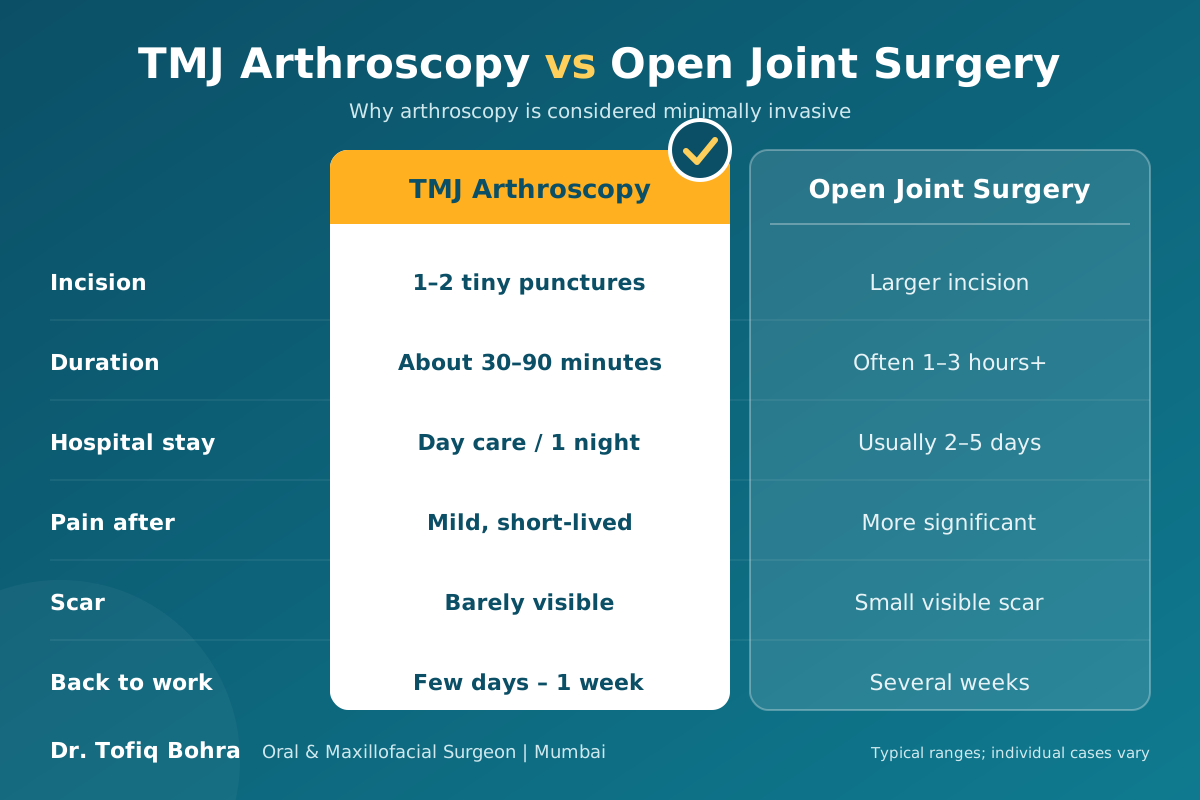
| Factor | TMJ Arthroscopy | Open Joint Surgery |
|---|---|---|
| Incision | 1–2 tiny punctures, a few mm each | Larger incision in front of the ear |
| Typical duration | About 30–90 minutes | Often 1–3 hours or more |
| Hospital stay | Day care or one night | Usually 2–5 days |
| Pain after surgery | Mild to moderate, short-lived | More significant |
| Scar | Barely visible | Small but visible scar |
| Return to work | Often within a few days to a week | Several weeks |
In simple terms, arthroscopy gives us many of the benefits of looking inside the joint, without the size and recovery of open surgery.
Who Needs TMJ Arthroscopy?
Most TMJ problems improve with medicines, splints, physiotherapy and lifestyle changes. I consider arthroscopy when:
- Jaw pain continues for months despite proper non-surgical treatment
- The jaw is "locked" and you can't open your mouth fully
- MRI shows a displaced disc, adhesions or inflammation inside the joint
- Arthrocentesis (a joint wash with needles) has helped only for a short time
- Early arthritis of the jaw joint is causing pain and restricted movement
What Happens on the Day of the Procedure?
- Pre-operative check: Blood tests, a fitness check, and a review of your MRI or CT scans.
- Anaesthesia: The procedure is done under general anaesthesia, so you are asleep and feel nothing.
- The procedure: The arthroscope is placed into the joint through a tiny puncture, and treatment is carried out while viewing the joint on a screen.
- Recovery room: You wake up within a short time. A small dressing covers the puncture site.
- Going home: Most patients are discharged the same day or the next morning, with medicines and a jaw exercise plan.
Recovery After TMJ Arthroscopy
- First few days: Mild swelling and soreness near the ear, managed with medicines and cold packs.
- Diet: Soft food for about 1–2 weeks, then a gradual return to normal.
- Jaw exercises: Started early. These are essential to keep the joint moving and prevent stiffness.
- Work: Most people with desk jobs return within a few days to a week.
- Full benefit: Improvement continues over several weeks as the joint settles.
Are There Any Risks?
Every procedure carries some risk, even a minimally invasive one. With arthroscopy, complications are uncommon, and most are temporary:
- Swelling, bruising or a feeling of fullness in the ear
- Temporary numbness near the puncture site
- Temporary change in bite
- Rarely, temporary weakness of the facial muscles near the eyebrow
- Infection or bleeding, which are rare
These risks are lowest when the procedure is performed by a surgeon with dedicated training and regular experience in TMJ arthroscopy.
Is TMJ Arthroscopy Successful?
In carefully selected patients, especially those with a locked jaw, disc problems or inflammation, arthroscopy can significantly reduce pain and improve mouth opening. The key words are carefully selected. Arthroscopy is not the answer for every TMJ problem. Severe joint destruction or a fused joint (ankylosis) may need open surgery or joint replacement instead.
My Advice
If you've been told you need "TMJ surgery," don't panic. Ask whether a minimally invasive option like arthroscopy is suitable for you before considering anything bigger. A proper examination and MRI will show which treatment fits your joint.
You can read more about the procedure and my approach as a TMJ arthroscopy surgeon in Mumbai.
Frequently Asked Questions
Is TMJ arthroscopy painful?
You are under general anaesthesia during the procedure, so you feel nothing. Afterwards, most patients have mild to moderate soreness for a few days, which is controlled with medicines.
How long does TMJ arthroscopy take?
Usually about 30 to 90 minutes, depending on whether one or both joints are treated and what needs to be done inside the joint.
Will I have a scar after TMJ arthroscopy?
Only one or two tiny puncture marks in front of the ear, which usually fade and become barely noticeable.
How soon can I eat normally after TMJ arthroscopy?
A soft diet is recommended for about 1–2 weeks, followed by a gradual return to your normal diet as advised by your surgeon.
Is TMJ arthroscopy better than open surgery?
For suitable cases, yes. It offers smaller incisions, less pain and faster recovery. But advanced arthritis, joint destruction or ankylosis may still need open surgery or joint replacement.
Suffering from jaw pain, clicking or a locked jaw?
Book a consultation with Dr. Tofiq Bohra to find out if TMJ arthroscopy is right for you.
Book an AppointmentDisclaimer: This article is for general information only and is not a substitute for a medical consultation. Treatment, recovery and risks vary from patient to patient.