
Can MBBS do OMFS?
- Home
- Blog
Oral and maxillofacial surgery (OMFS) sits right between dentistry and medicine, so many MBBS students and doctors ask whether they can become oral and maxillofacial surgeons. The short answer depends on the country. In India, an MBBS degree alone does not make you eligible for OMFS, but there are related surgical paths that cover much of the same work. Here is how it works.
Quick answer
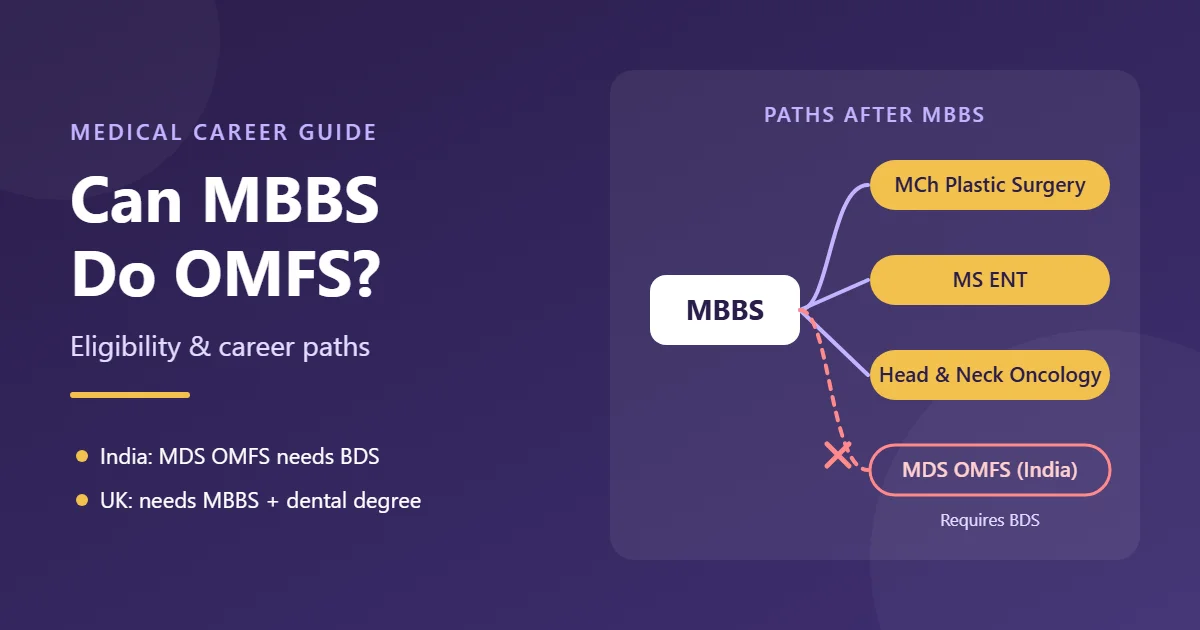
- In India, OMFS is a dental specialty. You need a BDS degree to do MDS in Oral and Maxillofacial Surgery, so MBBS graduates cannot take this route directly.
- MBBS doctors can reach face, jaw and head and neck surgery through MS ENT, or through MS General Surgery followed by MCh Plastic Surgery or MCh Head and Neck Oncology.
- In the UK and some European countries, OMFS surgeons need both a medical and a dental degree. A doctor with MBBS can do a shortened dental degree to qualify.
- In the US, a dental degree (DDS/DMD) is required. Some OMFS programmes also include a medical degree.
What Is OMFS?
Oral and maxillofacial surgery treats problems of the mouth, teeth, jaws, face and neck. OMFS surgeons remove impacted wisdom teeth, place dental implants, correct jaw alignment, repair facial fractures, treat TMJ disorders, manage cysts and tumours of the jaws, and help repair cleft lip and palate.
Because the work involves both teeth and wider facial surgery, different countries have set up training in different ways. That is why the answer to "Can MBBS do OMFS?" is not the same everywhere.
Can MBBS Do OMFS in India?
In India, Oral and Maxillofacial Surgery is a postgraduate dental course: MDS (Master of Dental Surgery) in Oral and Maxillofacial Surgery. It is regulated by the Dental Council of India (DCI), and admission is through NEET MDS.
To be eligible for NEET MDS, you must hold a BDS degree and complete the compulsory rotatory internship. An MBBS degree does not meet this requirement. This means an MBBS graduate cannot directly join MDS OMFS.
The only way for an MBBS doctor to do MDS OMFS in India is to also complete a BDS degree. That takes several years, so very few people choose this path.
Note: Eligibility rules can change. Always check the latest NEET MDS information bulletin and DCI regulations before planning your career.
Surgical Paths for MBBS Doctors Interested in the Face and Jaws
If you are an MBBS graduate drawn to facial and jaw surgery, several medical specialties overlap strongly with OMFS.
1. MS ENT (Otorhinolaryngology)
ENT surgeons treat the ear, nose, throat, sinuses and larynx, and many work in head and neck surgery. With further training, ENT surgeons can do facial plastic surgery, head and neck cancer surgery and some facial trauma work.
2. MS General Surgery + MCh Plastic Surgery
Plastic and reconstructive surgeons repair facial injuries, perform cleft lip and palate surgery, and reconstruct the face after cancer surgery. With a craniofacial fellowship, they can also treat complex skull and facial deformities. This is the closest medical route to much of OMFS work.
3. MS General Surgery or MS ENT + MCh Head and Neck Surgical Oncology
This path focuses on cancers of the mouth, jaws, throat and neck, including tumour removal and reconstruction. Oral cancer is common in India, so this field has a high demand for trained surgeons.
OMFS vs. Related Medical Specialties
| Path | Degree needed first | Main focus |
|---|---|---|
| MDS Oral & Maxillofacial Surgery | BDS | Teeth, jaws, implants, jaw surgery, facial fractures, TMJ |
| MS ENT | MBBS | Ear, nose, throat, sinuses, head and neck |
| MCh Plastic Surgery | MBBS + MS General Surgery | Facial reconstruction, cleft surgery, trauma, cosmetic surgery |
| MCh Head & Neck Oncology | MBBS + MS General Surgery or MS ENT | Cancers of the mouth, throat and neck |
How Other Countries Handle It
United Kingdom
In the UK, OMFS surgeons must hold both a medical and a dental degree. Doctors with an MBBS can enter a shortened, graduate-entry dental course, then complete core surgical training and specialty training in OMFS. The path is long, often more than 15 years in total, but MBBS graduates are welcome on it.
United States
In the US, OMFS is a dental specialty. Applicants need a dental degree (DDS or DMD) to enter a 4–6 year OMFS residency. Some programmes are 6 years long and include a medical degree (MD). A doctor with only a medical degree would first need to go to dental school.
Europe and Other Countries
Many European countries, such as Germany, also require both medical and dental degrees for maxillofacial surgery. In some countries it is a purely medical specialty. Rules vary widely, so check with the medical council of the country where you want to work.
Should You Do BDS After MBBS for OMFS?
For most MBBS graduates in India, doing BDS just to enter OMFS is not practical. It adds years of study before you can even begin MDS. Plastic surgery, ENT or head and neck oncology let you work on the face and jaws while building on the degree you already have.
However, if you plan to work in the UK or Europe, where both degrees are required, being dual-qualified can be a real advantage. Think about where you want to practise before you decide.
Frequently Asked Questions
Can an MBBS doctor give NEET MDS?
No. NEET MDS is open only to candidates with a BDS degree and a completed internship.
Is OMFS a medical or dental specialty?
In India and the US, it is a dental specialty. In the UK and several European countries, it requires both medical and dental qualifications.
Which MBBS specialty is closest to OMFS?
Plastic and reconstructive surgery (MCh) is closest, especially with craniofacial training. ENT and head and neck surgical oncology also overlap a lot with OMFS work.
Can a BDS graduate do MBBS later?
Yes, but they must qualify through NEET UG like any other candidate and complete the full MBBS course. Some OMFS surgeons do this to become dual-qualified.
The Bottom Line
An MBBS degree alone cannot lead to OMFS in India, because MDS Oral and Maxillofacial Surgery requires BDS. But MBBS doctors still have strong paths into facial and jaw surgery through plastic surgery, ENT and head and neck oncology. In the UK and parts of Europe, MBBS is actually part of the OMFS route, as long as you also complete a dental degree. Choose your path based on the kind of surgery you want to do and the country where you plan to practise.
Disclaimer: This article is for general career guidance only. Admission rules and eligibility criteria are set by regulatory bodies and can change. Always check the latest official notifications from the NBEMS, DCI, NMC or the relevant authority in your country.