
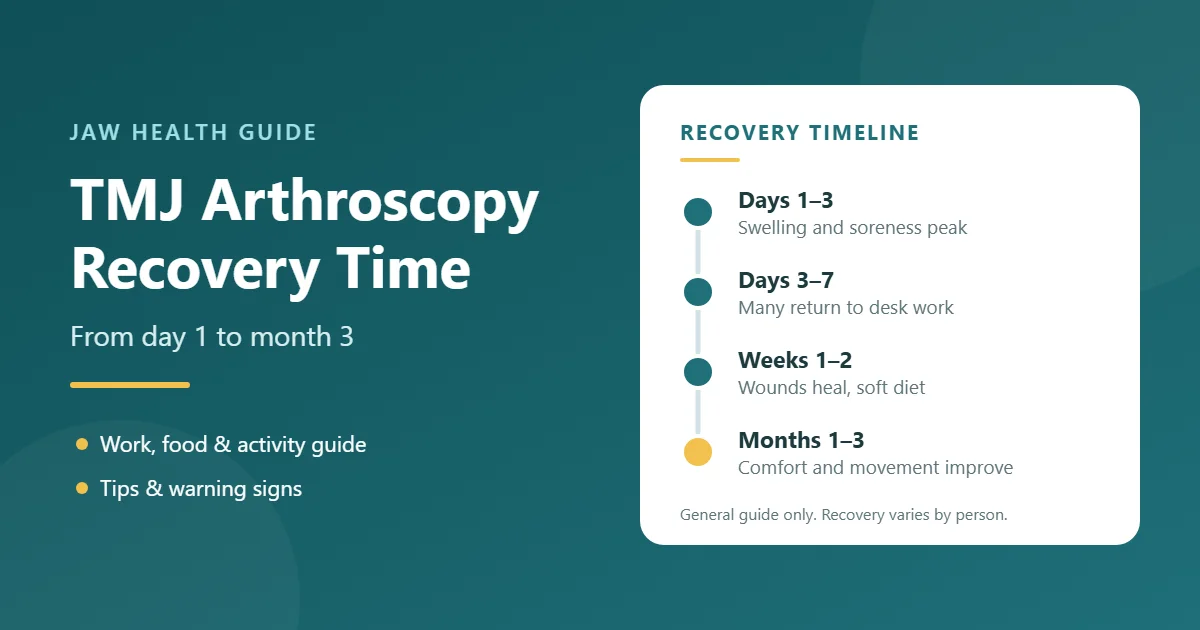
TMJ arthroscopy recovery time
- Home
- Blog
Most people recover from the early effects of TMJ arthroscopy within about 1–2 weeks. Many return to desk work or study within 3–7 days, while full recovery of jaw movement and comfort can take 1–3 months or longer. Your own recovery depends on what was done inside the joint, how long you had symptoms and how closely you follow your aftercare plan.
Quick answer
- Going home: often the same day or after one night
- Desk work or study: often within 3–7 days
- Main swelling and soreness: usually much better within about a week
- Soft diet: often 1–2 weeks, sometimes longer
- Fuller recovery: about 1–3 months, and longer for more complex procedures
TMJ Arthroscopy Recovery Timeline
| Time after surgery | What to expect |
|---|---|
| Day of surgery | Drowsiness, numbness near the ear and mild soreness. Rest and take liquids or soft food as advised. |
| Days 1–3 | Swelling, stiffness and soreness are usually at their worst. Your ear may feel blocked and your bite may feel different. |
| Days 4–7 | Swelling and pain start to ease. Many people return to desk work or study. |
| Weeks 1–2 | The small wounds heal. Any stitches dissolve or are removed. Jaw opening gradually improves. |
| Weeks 2–6 | You return to more normal foods and activities as your surgeon allows. Jaw exercises continue. |
| Months 1–3 | Comfort, strength and movement continue to improve. |
| After 3 months | Some people, especially those with long-standing problems or more complex procedures, continue to improve. |
These times are a general guide. Follow the plan your own surgeon gives you.
When Can You Return to Normal Activities?
| Activity | Typical guide |
|---|---|
| Gentle walking | From the day after surgery, if you feel well |
| Desk work or study | Often 3–7 days |
| Jobs with a lot of talking | Often 1–2 weeks |
| Physical work or gym | Often about 2 weeks or more |
| Contact sports | Only when your surgeon clears you |
| Driving | Not for at least 24 hours after sedation or general anaesthesia, or while taking medicines that make you drowsy |
| Swimming | After the wounds have fully healed and your surgeon agrees |
What to Eat During Recovery
First Few Days
Choose liquids and very soft foods such as lukewarm soups, dal, curd, smoothies, milk and well-cooked khichdi. Avoid very hot food while any part of your mouth or face is numb.
Weeks 1–2
Add soft foods such as idli, upma, soft rice, scrambled eggs, paneer, mashed vegetables and bananas. Cut food into small pieces and chew gently.
After 2 Weeks
Slowly return to normal food when your surgeon agrees. Leave hard, crunchy and chewy foods such as nuts, tough meat, chewing gum and hard sweets until last.
Jaw Exercises and Physiotherapy
Jaw exercises are an important part of recovery. They help prevent stiffness and scar tissue inside the joint. Your surgeon or physiotherapist will tell you when to start, which exercises to do and how often.
- Begin gently and increase movement gradually.
- Mild stretching is expected, but sharp pain is not.
- Do short sessions regularly instead of one long session.
- Don't force your mouth open.
- Continue for as long as you are advised, even after you feel better.
Normal Symptoms During Recovery
- Soreness and swelling in front of the ear
- Limited mouth opening
- A blocked or full feeling in the ear
- Back teeth not meeting normally for a few days
- Mild numbness near the incision
- Jaw tiredness after talking or chewing
- Some clicking, which may continue even when pain improves
What Affects Recovery Time?
- Type of procedure: a joint washout usually has a quicker recovery than disc repositioning or other operative work.
- One or both joints: surgery on both sides may take longer to recover from.
- Severity of the joint problem: advanced joint damage may improve more slowly.
- How long you had symptoms: tight muscles and long-term pain can take time to settle.
- Grinding or clenching: this puts extra pressure on the healing joint.
- General health and smoking: smoking and some medical conditions can slow healing.
- Following instructions: exercises, diet and follow-up visits all make a difference.
Tips for a Smoother Recovery
- Take medicines exactly as prescribed.
- Use a cold pack wrapped in cloth during the first 48 hours, if advised.
- Sleep with your head slightly raised for the first few nights.
- Keep the wound clean and dry as instructed.
- Support your chin when you yawn.
- Avoid chewing gum, nail biting and resting your chin on your hand.
- Wear your splint or night guard if your surgeon recommends it.
- Don't smoke.
When to Contact Your Surgeon
Call your surgeon promptly if you have:
- Pain or swelling that gets worse after the first 3 days
- Fever, pus, or increasing redness around the wound
- Weakness in the face, or difficulty closing your eye
- Hearing loss, ear discharge or severe dizziness
- Mouth opening that is getting worse
- A bite that still feels different after the first week
Seek emergency care immediately if you have difficulty breathing or swallowing, rapidly increasing swelling, or bleeding that does not stop.
Frequently Asked Questions
How long does it take to recover from TMJ arthroscopy?
Early recovery usually takes about 1–2 weeks. Jaw movement and comfort may continue to improve for 1–3 months or longer.
How long should I take off work?
Many people need 3–7 days off desk work. Physical jobs, or jobs that need a lot of talking, may need more time.
When can I eat normally?
Many people stay on soft food for 1–2 weeks and then return to normal food gradually. Some procedures need a longer soft diet.
When will I be able to open my mouth fully?
Opening usually improves over several weeks with exercises. Some people may not regain completely normal opening, especially if joint damage is advanced.
Is clicking normal after TMJ arthroscopy?
It can be. Surgery mainly aims to reduce pain and improve function, and some clicking may remain. Tell your surgeon if it comes with pain or locking.
How long does swelling last?
Swelling is usually greatest in the first 2–3 days and settles noticeably over about a week.
The Bottom Line
TMJ arthroscopy usually has a shorter recovery than open jaw joint surgery. Many people return to light activities within a week and continue to improve over the next 1–3 months. Soft food, regular jaw exercises and follow-up care can help you recover well. Contact your surgeon if your symptoms get worse instead of better.
Medical disclaimer: This article is for general information only and is not a substitute for professional medical advice. Recovery differs between patients, so always follow your surgeon's instructions.
If your doctor has suggested TMJ arthroscopy for jaw pain, clicking or locking, it is natural to worry about how painful it will be. The good news is that TMJ arthroscopy is a minimally invasive procedure, and you should not feel pain during it. Most people have mild to moderate soreness for a few days afterwards, which is usually well controlled with medicines, ice and rest. This guide explains what the pain feels like, how long it lasts and how to stay comfortable during recovery.
Quick answer
- You should not feel pain during TMJ arthroscopy. It is usually done under general anaesthesia, or sometimes under local anaesthesia with sedation.
- Afterwards, most people have mild to moderate soreness, swelling and jaw stiffness in front of the ear.
- Discomfort is usually worst in the first 2–3 days and improves noticeably within about a week.
- Pain is generally less than after open jaw joint surgery, because only one or two tiny incisions are made.
- Painkillers, ice packs, a soft diet and gentle jaw exercises help most people recover comfortably.
What Is TMJ Arthroscopy?
The temporomandibular joint (TMJ) connects your lower jaw to your skull, just in front of each ear. In TMJ arthroscopy, an oral and maxillofacial surgeon inserts a very thin camera into the joint through a small puncture, usually 2–5 mm wide. Through this and sometimes one more small opening, the surgeon can wash out the joint, release adhesions, remove inflamed tissue or reposition the disc.
Because the openings are so small, there is much less tissue damage than with open joint surgery. This is the main reason the pain afterwards is usually manageable.
Is TMJ Arthroscopy Painful During the Procedure?
No. You should not feel pain during the procedure.
- General anaesthesia: most commonly used. You are fully asleep and feel nothing.
- Local anaesthesia with sedation: sometimes used for shorter procedures. The area is numbed, and you are relaxed and drowsy. You may feel some pressure or movement, but not sharp pain.
A long-acting local anaesthetic is often injected into the area during surgery, so the joint stays numb for several hours after you wake up.
What Does the Pain Feel Like After Surgery?
Most people describe the feeling as a dull ache or soreness rather than sharp pain. Common sensations include:
- Aching or tenderness in front of the ear
- Swelling on the side of the face
- Jaw stiffness and difficulty opening the mouth fully
- A blocked or full feeling in the ear
- Your back teeth not meeting properly on the operated side for a few days, caused by swelling in the joint
- Mild headache or tiredness after anaesthesia
- Slight numbness of the skin near the incision
These effects are normal and usually settle as the swelling goes down.
TMJ Arthroscopy Pain Timeline
| Time after surgery | What you may feel |
|---|---|
| First 24 hours | The area may stay numb at first. Soreness begins as the anaesthetic wears off. Swelling starts to appear. |
| Days 2–3 | Discomfort and swelling are usually at their peak. Jaw stiffness and an ear-fullness feeling are common. |
| Days 4–7 | Pain steadily eases. Many people need fewer painkillers and can return to light work or study. |
| Weeks 2–4 | Mild ache or tiredness in the jaw after chewing or talking. Mouth opening improves with exercises. |
| 1–3 months | The joint continues to heal. Most people notice less jaw pain than they had before surgery. |
Everyone heals differently. Your recovery depends on your condition, what was done inside the joint and how closely you follow aftercare advice.
How Pain After TMJ Arthroscopy Is Managed
Medicines
Your surgeon will usually prescribe painkillers, often paracetamol and an anti-inflammatory medicine, if these are safe for you. Stronger pain relief may be given for the first day or two if needed. Take medicines exactly as prescribed, and don't combine them with other painkillers without medical advice.
Cold and Warm Packs
- First 48 hours: apply a cold pack wrapped in a cloth to the side of the face for 15–20 minutes at a time to reduce swelling.
- After 48 hours: your surgeon may recommend warm compresses to relax the muscles and ease stiffness.
Soft Diet
Eat soft foods such as khichdi, dal, curd, soups, mashed vegetables, eggs and smoothies for the period your surgeon advises, often 1–2 weeks. Avoid hard, chewy and crunchy foods, and cut food into small pieces.
Jaw Rest and Exercises
- Avoid opening your mouth very wide, chewing gum and biting on hard objects.
- Try to support your jaw when you yawn.
- Start the gentle jaw exercises or physiotherapy your surgeon recommends. They help reduce stiffness and prevent scar tissue inside the joint.
Rest and Sleep
Sleep with your head slightly raised for the first few nights to help reduce swelling. Try not to sleep on the operated side at first.
Is TMJ Arthroscopy Less Painful Than Open Jaw Surgery?
| Factor | TMJ arthroscopy | Open TMJ surgery |
|---|---|---|
| Incision | 1–2 tiny punctures | Longer incision in front of the ear |
| Pain after surgery | Usually mild to moderate | Usually more |
| Swelling | Usually less | Usually more |
| Hospital stay | Often same day or one night | Usually longer |
| Return to daily activities | Often within about a week | Usually takes longer |
What Can Make Recovery More Painful?
- Chewing hard food too early
- Opening the mouth too wide or talking for long periods in the first few days
- Teeth grinding or clenching, especially at night
- Skipping prescribed medicines or jaw exercises
- Stress, which can increase jaw muscle tension
- Long-standing jaw pain before surgery, which may take longer to settle
If you grind your teeth, ask your dentist or surgeon whether a night guard may help.
When to Contact Your Surgeon
Call your surgeon promptly if you have:
- Pain that gets worse after the first few days instead of better
- Pain that is not controlled by your prescribed medicines
- Fever, increasing redness, warmth or pus from the incision
- Swelling that keeps increasing after day 3
- Weakness of the face, such as difficulty raising your eyebrow or closing your eye
- Hearing loss, ear discharge or severe ear pain
- Your teeth still not meeting properly after the first week
Seek emergency care if you have difficulty breathing or swallowing, or swelling that spreads rapidly.
Frequently Asked Questions
How painful is TMJ arthroscopy on a scale of 1 to 10?
Pain is personal, so there is no single number. Most people describe it as mild to moderate soreness for the first few days, which becomes much easier to manage within about a week with medicines and rest.
How long does pain last after TMJ arthroscopy?
Discomfort usually peaks in the first 2–3 days and improves within about a week. Mild aching after eating or talking may continue for a few weeks.
Will I be able to eat after TMJ arthroscopy?
Yes. You can usually start with liquids and soft foods on the same day or the next day. Your surgeon will tell you when you can return to a normal diet.
When can I go back to work after TMJ arthroscopy?
Many people return to desk work or study within about 3–7 days. If your job involves a lot of talking or physical effort, you may need a little longer.
Does TMJ arthroscopy leave a scar?
It leaves one or two tiny marks in front of the ear, which usually fade to faint dots within 6–12 months.
Is the pain worth it?
For many patients whose jaw pain or locking hasn't improved with splints, medicines and physiotherapy, TMJ arthroscopy can reduce pain and improve mouth opening. Ask your surgeon about the expected benefit for your specific condition.
The Bottom Line
TMJ arthroscopy is not painful during the procedure, because you are under anaesthesia. Afterwards, most people have mild to moderate soreness, swelling and stiffness for a few days, which improves steadily over the first week. Painkillers, cold packs, a soft diet and gentle jaw exercises make recovery much more comfortable. If your pain gets worse instead of better, or you notice any warning signs, contact your surgeon promptly.
Medical disclaimer: This article is for general information only and is not a substitute for professional medical advice. Always follow the instructions of your oral and maxillofacial surgeon about pain relief and recovery.