
What is Oral and Maxillofacial Surgery for?
- Home
- Blog
Oral and maxillofacial surgery is a branch of surgery that treats problems of the mouth, teeth, jaws, face and neck. It is used for many things: removing a painful wisdom tooth, replacing missing teeth with implants, fixing a broken jaw, correcting a misaligned bite, and treating cysts, tumours and serious infections. This guide explains what the surgery is for, the main procedures, and what to expect.
Quick answer
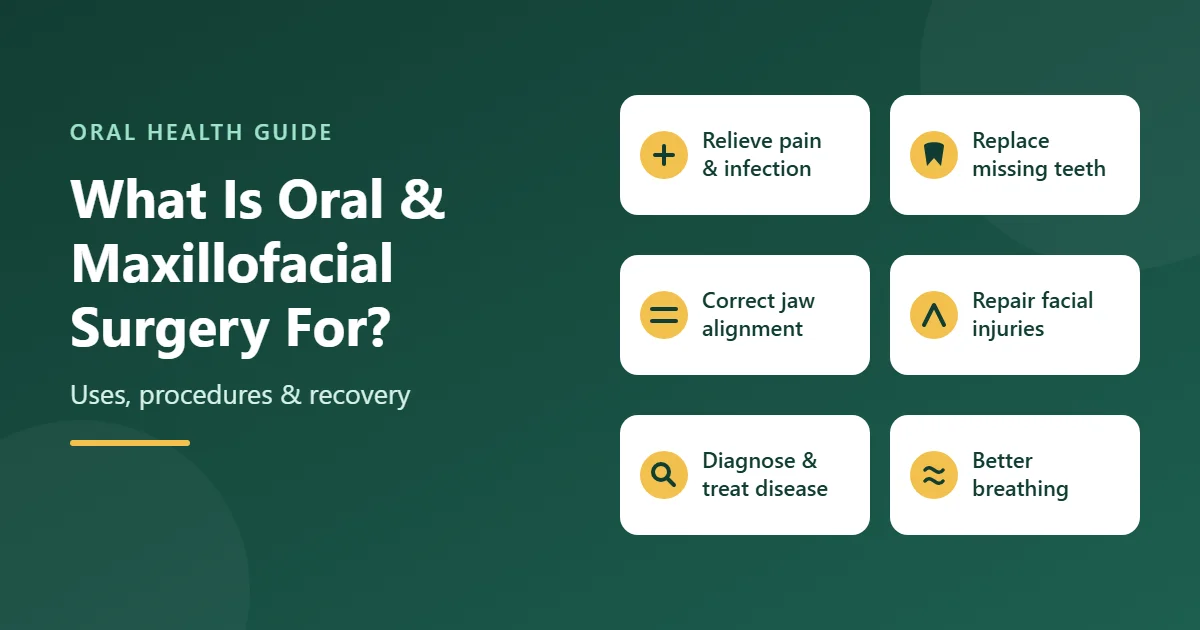
- Oral and maxillofacial surgery is used to relieve pain and infection, restore chewing, speaking and breathing, repair injuries, correct jaw and facial deformities, and diagnose and treat disease.
- Common procedures include wisdom tooth removal, dental implants, corrective jaw surgery, facial fracture repair, TMJ treatment and biopsies.
- It is performed by an oral and maxillofacial surgeon, a specialist trained in both dentistry and surgery.
- Many procedures are done under local anaesthesia or sedation, often as day-care surgery.
What Does "Oral and Maxillofacial" Mean?
"Oral" means the mouth. "Maxillofacial" refers to the jaws (maxilla is the upper jaw) and the face. So oral and maxillofacial surgery covers the teeth, gums, jawbones, jaw joints, face, and parts of the head and neck.
Because this area controls how we eat, speak, breathe and look, problems here can affect daily life in many ways. That is why this surgery has such a wide range of uses.
What Is Oral and Maxillofacial Surgery Used For?
1. To Relieve Pain and Treat Infection
Impacted wisdom teeth, badly broken teeth and dental abscesses can cause severe pain, swelling and infection. Surgery removes the cause of the problem. Serious infections that spread into the face or neck may need urgent drainage to prevent life-threatening complications.
2. To Replace Missing Teeth
Dental implants are titanium or ceramic posts placed in the jawbone to support artificial teeth. When the jawbone is too thin, surgeons can first rebuild it with bone grafting or a sinus lift. Implants restore chewing, protect the jawbone and give a natural-looking smile.
3. To Correct Jaw Alignment
Some people have jaws that grow out of balance, causing an underbite, overbite, open bite or facial asymmetry. Corrective jaw surgery (orthognathic surgery), usually combined with braces, repositions the jaws. This improves chewing, speech, breathing and facial balance.
4. To Repair Facial Injuries
Road accidents, falls, sports injuries and assaults can break the jaw, cheekbone, eye socket or nose, or cause deep cuts to the face and mouth. Oral and maxillofacial surgery restores the bones to their correct position so the face heals properly and the bite works again.
5. To Treat Jaw Joint (TMJ) Problems
The temporomandibular joint (TMJ) connects the lower jaw to the skull. Pain, clicking or locking of this joint is usually treated first with splints, medication and physiotherapy. When these don't help, procedures such as arthrocentesis, arthroscopy, open joint surgery or joint replacement may be used.
6. To Diagnose and Treat Disease
Lumps, ulcers, white or red patches and swellings in the mouth sometimes need a biopsy to find out what they are. Surgeons remove cysts and benign tumours of the jaws, and some treat oral cancer and rebuild the area after the tumour is removed.
7. To Repair Birth Differences
Cleft lip and palate is one of the most common birth differences. Oral and maxillofacial surgeons work within cleft teams to repair the lip, palate and gum, and later correct jaw growth if needed. This helps children feed, speak and smile normally.
8. To Improve Breathing During Sleep
For some people with obstructive sleep apnea who cannot use a CPAP machine, moving the jaws forward (maxillomandibular advancement) can widen the airway and reduce breathing problems during sleep.
9. To Enhance Facial Appearance
Some procedures are done mainly for appearance, such as chin surgery, jaw contouring or cheek augmentation. These are offered depending on the surgeon's training and local rules.
Common Oral and Maxillofacial Procedures at a Glance
| Procedure | What it is for |
|---|---|
| Wisdom tooth removal | Impacted, infected or painful wisdom teeth |
| Surgical extraction | Broken, deeply decayed or hard-to-reach teeth |
| Dental implants | Replacing one or more missing teeth |
| Bone grafting / sinus lift | Building up jawbone before implants |
| Orthognathic surgery | Correcting misaligned jaws and bite |
| Fracture fixation | Repairing broken facial bones and jaws |
| TMJ arthrocentesis / arthroscopy | Treating jaw joint pain, locking and stiffness |
| Biopsy and cyst removal | Diagnosing and treating lumps, ulcers and cysts |
| Cleft repair | Correcting cleft lip and palate |
| Abscess drainage | Treating spreading dental or facial infections |
Signs You May Need Oral and Maxillofacial Surgery
- Pain, swelling or repeated infection around a back tooth
- Missing teeth that you want to replace permanently
- Difficulty chewing, biting or speaking because of how your jaws meet
- Jaw pain, clicking or locking that doesn't improve with other treatment
- A sore, lump or patch in the mouth that hasn't healed in 2–3 weeks
- An injury to the face or jaw
- Loud snoring with pauses in breathing at night
Go to an emergency department immediately if you have rapidly spreading swelling of the face or neck, difficulty breathing or swallowing, or a suspected broken jaw.
Is Oral and Maxillofacial Surgery Painful?
You should not feel pain during the procedure. Depending on the surgery, it is done under:
- Local anaesthesia: the area is numbed and you stay awake.
- IV sedation: you are relaxed and drowsy, and often remember little.
- General anaesthesia: you are fully asleep, usually for longer or more complex operations.
Some soreness, swelling and stiffness afterwards is normal. It is usually controlled with painkillers, cold packs and rest.
Recovery: What to Expect
- Minor procedures such as tooth extractions: most people return to normal activities within 2–5 days.
- Dental implants: the surgery heals in 1–2 weeks, but the implant needs about 3–6 months to fuse with the bone before the final tooth is fitted.
- Jaw surgery or fracture repair: initial recovery takes about 2–6 weeks, with a soft diet, and full bone healing takes several months.
Following your surgeon's advice on diet, oral hygiene, medication and follow-up visits helps you heal faster and reduces the risk of complications.
Risks and Possible Complications
Like any surgery, oral and maxillofacial procedures carry some risks. These include:
- Bleeding, swelling and bruising
- Infection
- Dry socket after tooth extraction
- Temporary or, rarely, lasting numbness of the lip, chin or tongue
- Implant failure, in a small number of cases
Your surgeon will explain the specific risks of your procedure and how to reduce them before you agree to treatment.
Frequently Asked Questions
Who performs oral and maxillofacial surgery?
An oral and maxillofacial surgeon. They are trained in dentistry and then complete several years of hospital-based surgical training. In some countries they also hold a medical degree.
Is oral surgery the same as oral and maxillofacial surgery?
Oral surgery usually refers to procedures inside the mouth, such as extractions and implants. Oral and maxillofacial surgery is broader and also covers the jaws, face and neck.
Is oral and maxillofacial surgery safe?
Yes, when performed by a qualified specialist. Most procedures are routine and have high success rates. Serious complications are uncommon.
How long does oral and maxillofacial surgery take?
It depends on the procedure. A simple extraction may take 20–40 minutes, while corrective jaw surgery can take several hours.
The Bottom Line
Oral and maxillofacial surgery is for much more than pulling teeth. It relieves pain and infection, replaces missing teeth, repairs injuries, corrects jaw and facial problems, treats disease and can even improve breathing during sleep. If you have a problem with your teeth, jaws or face that other treatment hasn't solved, an oral and maxillofacial surgeon can help you understand your options.
Medical disclaimer: This article is for general information only and is not a substitute for professional medical or dental advice. Always consult a qualified oral and maxillofacial surgeon or healthcare provider about your own condition and treatment.