
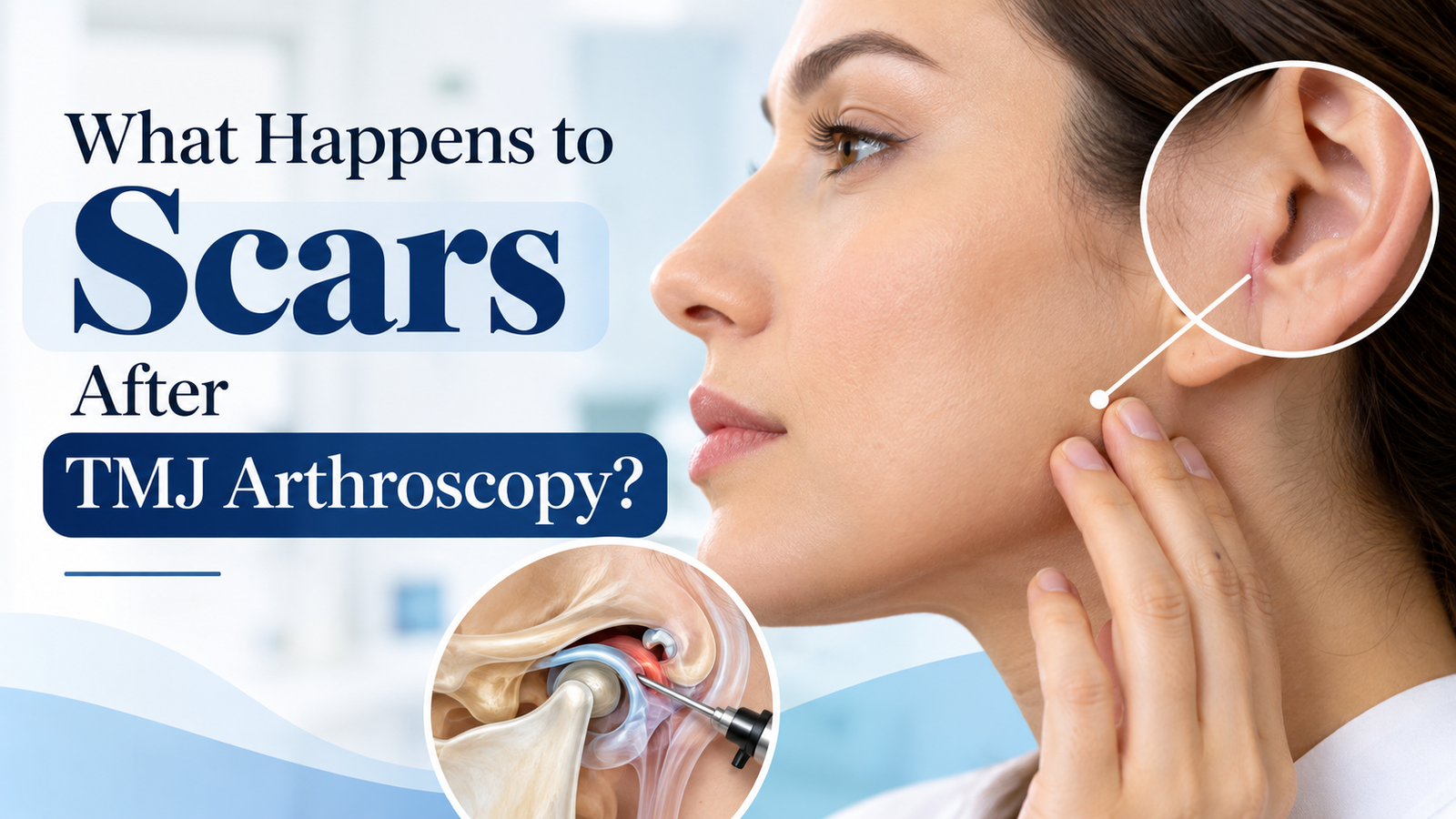
What happens to scars after TMJ arthroscopy?
- Home
- Blog
In my practice, I have noticed something interesting. Patients come to me with months, sometimes years, of jaw pain, clicking, or locking. Yet when I suggest TMJ arthroscopy, one of their biggest worries is not the joint at all. It is the skin: "Doctor, will people see a mark on my face?"
I want to answer that question clearly, because the reality is far more reassuring than most people expect. In this article, I will explain where the marks are made, how they change over time, what can make them more or less visible, and how you can help your skin heal as neatly as possible.
The Short Version
TMJ arthroscopy is performed through one or two very small skin punctures, each typically only a few millimetres wide, placed just in front of the ear. These usually heal into a tiny dot or a very fine line. In the early weeks they look pink, but they steadily fade, and for most of my patients they become difficult to see within a few months. The final appearance is reached at around 9–12 months.
Where Exactly Are the Marks?
The temporomandibular joint lies directly in front of the ear canal. To reach it, I make small entry points in the skin just ahead of the ear, at the level of the joint. Wherever the anatomy allows, I place them within or along the natural crease where the ear meets the cheek.
This location works in your favour for three reasons:
- Natural skin folds hide marks. A small scar sitting in a crease is far less noticeable than one on flat skin.
- The area is partly shadowed by the ear and, in many people, by the hair.
- Facial skin heals well. The face has an excellent blood supply, which helps small wounds close quickly and neatly.
Why Arthroscopy Scars Are So Small
Arthroscopy is keyhole surgery. Instead of opening the joint, I introduce a very slim camera and fine instruments through the punctures. The skin is gently parted rather than cut along a long line, and there is minimal disturbance to the tissues beneath. The smaller the wound and the less tension on it, the finer the scar that forms.
For comparison, open TMJ surgery needs a longer incision along the front of the ear. Even that scar usually heals well in the skin crease, but arthroscopy leaves considerably less to heal.
The Life Cycle of an Arthroscopy Scar
Stage 1: Closing the Wound (First Week)
Immediately after surgery, the punctures are closed with a fine stitch or adhesive strips and covered with a small dressing. Over the first few days, the body forms a seal across the wound. You may notice mild swelling and tenderness in front of the ear, mostly from the joint itself rather than the skin.
Stage 2: Building New Tissue (Weeks 1–4)
Stitches or strips are usually removed within about a week. The marks now look pink or red, and may feel slightly firm or raised. This is because the body is laying down fresh collagen and new blood vessels to rebuild the skin. Many patients worry at this stage, but this appearance is completely expected and temporary.
Stage 3: Softening and Fading (Months 1–6)
Gradually, the extra blood vessels shrink and the collagen reorganises into a neater pattern. The mark becomes flatter, softer, and paler. By around three months, most patients find it hard to point out, and by six months it often blends into the surrounding skin.
Stage 4: Final Maturation (Months 6–12)
The scar continues to refine quietly in the background. By about a year, it has reached its final appearance: typically a small, pale dot or hairline mark that is very difficult for others to notice.
A scar at six weeks is a work in progress, not a final result. I always ask my patients to be patient with their skin, because it keeps improving long after they stop thinking about it.
What Affects How Your Scar Will Look?
| Factor | Why it matters |
|---|---|
| Skin type | Darker skin, including most Indian skin types, is more likely to develop temporary dark marks (hyperpigmentation) during healing. |
| Keloid tendency | People with a personal or family history of keloids or thick scars have a higher chance of a raised scar, even from a small wound. |
| Sun exposure | UV light can darken fresh scar tissue and make it more noticeable for longer. |
| Smoking | Reduces blood flow to the skin and slows healing. |
| Infection | Delays wound closure and can lead to a wider scar. |
| Picking or rubbing | Disturbs the healing surface and can widen or darken the mark. |
| General health | Poorly controlled diabetes and poor nutrition can slow skin repair. |
My Aftercare Routine for Neater Scars
The First Two Weeks
- Keep the dressing clean and dry for the first 24–48 hours, or as advised.
- After that, clean gently around the marks as instructed, and pat dry.
- Do not soak the area: avoid swimming, steam, and saunas until the wound is fully closed.
- Let any small scabs fall off on their own.
- Avoid makeup or creams directly on the wound until it has sealed.
From About Two Weeks Onwards
- Silicone gel or silicone sheets: once the skin is fully closed, these help keep the scar flat, soft, and less red. Use them as directed, usually for 2–3 months.
- Sunscreen every day: a broad-spectrum SPF 30 or higher on the area, reapplied when outdoors, for at least 6 months.
- Gentle massage: when I confirm the skin is ready, usually after 3–4 weeks, light circular massage for a minute or two each day can help soften the scar.
- Moisturise: keeping the skin supple supports better remodelling.
Things I Ask My Patients to Avoid
- Home remedies applied to an open wound (turmeric pastes, oils, or other mixtures) before it has fully closed
- Bleaching or harsh lightening creams on a fresh scar
- Smoking during the healing period
- Unprotected sun exposure in the first few months
When a Scar Needs Extra Attention
Most arthroscopy marks heal without any problem. Occasionally, a scar may become raised, thick, itchy, or darker than expected. This is not a reason to panic. These changes respond well to treatment, especially when caught early. Options may include:
- Continued or more intensive silicone therapy
- Steroid injections for raised (hypertrophic) scars or keloids
- Topical treatments for pigmentation
- Laser treatment or minor scar revision in selected cases
If you have a known tendency to form keloids, tell me before surgery. I can plan preventive measures from day one and see you more closely during healing.
Please Contact Your Surgeon If You Notice:
- Redness spreading around the puncture site, or increasing warmth and swelling
- Pus or discharge from the wound
- Fever after surgery
- A scar that is growing beyond the edges of the original wound
- Persistent itching or pain in the scar after it has healed
A Word From Me
Worry about a facial mark is understandable, but it should not stand between you and a treatment that can relieve years of jaw pain. TMJ arthroscopy was developed precisely to treat the joint with the least possible impact on the skin and surrounding tissues. With careful placement of the entry points and a little patience and care during healing, most of my patients end up with marks that they themselves can barely find.
If you have specific concerns about your skin or past scarring, bring them up at your consultation. Together, we can plan your treatment and aftercare so you feel confident about both your joint and your appearance.
Frequently Asked Questions
How big are the scars after TMJ arthroscopy?
The punctures are usually only a few millimetres wide. Once healed, they typically leave a tiny dot or fine line in front of the ear.
Will anyone be able to see my scar?
In the first few weeks, the marks may be visible as small pink spots. Over the following months they fade significantly, and because they sit near the natural ear crease, most people will not notice them once healing is complete.
Why does my scar look darker than my skin?
Temporary darkening (post-inflammatory hyperpigmentation) is common in darker skin types. Daily sunscreen and good scar care help it fade, and if it persists, topical treatments can help.
Can I use home remedies on the scar?
Avoid applying anything to the wound until it has fully closed and your surgeon has approved it. After that, proven options like silicone gel and sunscreen are the most reliable choices.
When will my scar look its best?
Most of the improvement happens within 3–6 months, but scars continue to mature for up to 12 months. The appearance at one year is generally the final result.
Disclaimer: This article is for general educational purposes and does not replace personal medical advice. Healing varies between individuals. Please follow the specific instructions given by your treating surgeon.